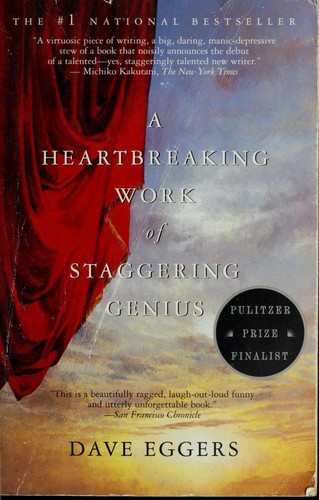
Talk to A Heartbreaking Work of Staggering Genius like its author wrote you back.
Get the ideas that fit your life — not generic summaries.
- Chat with the book
- Audiobook-style main ideas
- Adapts to your life and goals
- Helps you take action
What it argues
Dave Eggers's debut memoir about losing both parents to cancer within five weeks and raising his younger brother Toph while trying to start a literary magazine in San Francisco in the mid-1990s arrived in 2000 with unusual self-consciousness about its own nature. The book's preface — which parodies both literary conventions and the reader's relationship to confessional memoir — set its tone: this is a work that insists on being both earnest and ironic simultaneously, that is as interested in the mechanics of autobiography as in its content.
The parents die in the first hundred pages. The rest of the book is about what comes after: Eggers at twenty-one, suddenly the guardian of an eight-year-old brother, moving from Lake Forest, Illinois to Berkeley with Toph, sharing a house with his older sister Beth, and trying to figure out what adult life is. He founds the literary magazine Might with friends. He appears on the Real World. He applies to Survivor. He attends parties where everyone is performing their youth. Through it all, he is raising a child while being, himself, barely past childhood.
What it gets right
- 1.
Grief and irony are not mutually exclusive. Eggers uses postmodern self-consciousness as both a protective mechanism and a genuine formal argument — the book thinks about what books do while doing them.
- 2.
Young adulthood requires improvised parenthood. Eggers had no preparation for raising Toph and the memoir is essentially a record of figuring it out, including the parts he got wrong.
- 3.
The preface is not decorative. Its parody of legal and editorial conventions is the book's argument in miniature: memoir is a constructed document full of choices that are usually hidden.
What it covers
Who wrote it
Dave Eggers was born in 1970 in Boston and grew up in Lake Forest, Illinois. After losing both parents to cancer in 1991 and 1992, he moved to San Francisco and co-founded the satirical magazine Might. He subsequently founded McSweeney's, a literary publishing house, the youth writing nonprofit 826 Valencia, and Voice of Witness, an oral history series. He has written numerous books of fiction, memoir, and journalism, including What Is the What and Zeitoun. A Heartbreaking Work of Staggering Genius was a finalist for the Pulitzer Prize in 2001.
