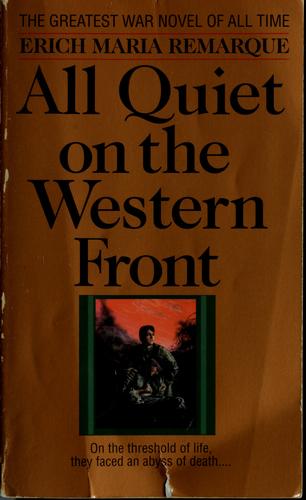
Talk to All Quiet on the Western Front like its author wrote you back.
Get the ideas that fit your life — not generic summaries.
- Chat with the book
- Audiobook-style main ideas
- Adapts to your life and goals
- Helps you take action
All Quiet on the Western Front, in detail
All Quiet on the Western Front follows Paul Bäumer, a young German soldier who enlists with his classmates during the First World War after being swept up in patriotic speeches. Remarque published the novel in 1929, a decade after the armistice, and it reads as a direct rebuttal to the romantic narratives of heroic sacrifice that had sent a generation to its death. Paul and his friends arrive at the front expecting a noble test. What they find is mud, artillery, rats, and the routine destruction of men they have come to know.
The novel's power comes from its deliberate smallness. Remarque does not attempt to narrate the war strategically or historically. There are no generals making decisions, no maps, no turning points. There is only the trench: the smells, the hunger, the dark humor soldiers develop to survive proximity to death. The friendships Paul forms — with the older, pragmatic Kat; with the sarcastic Tjaden; with others who gradually disappear — carry the emotional weight of the book. Each death removes another tether to the world Paul might return to.
The deeper damage is psychological. Paul goes home on leave and finds he can no longer talk to his family. Civilian life feels distant and slightly absurd. The only place that makes sense is the front, not because it is good but because it is legible — and because the people there understand what words cannot explain. Remarque captures a particular kind of alienation that would later be recognized across all twentieth-century wars: the soldier who survives but cannot fully return.
The book's final pages are quiet and brutal. By the end, nearly everyone Paul enlisted with is dead. The famous last paragraph is a masterpiece of understatement. All Quiet on the Western Front was burned in Germany in 1933 and has never gone out of print. It remains the most widely read anti-war novel in any language, not because it preaches, but because it shows.
The big ideas
- 1.
Patriotic rhetoric sent young men to a war that had nothing to do with their ideals. The gap between the language used to justify the war and the reality of the trenches is the novel's central subject.
- 2.
Front-line soldiers develop their own moral world. Loyalty is to the man next to you, not to abstractions like nation or honor.
- 3.
War damages survivors as much as it kills. Paul cannot reconnect with civilian life because the experience of the front has made ordinary life feel unreal.
