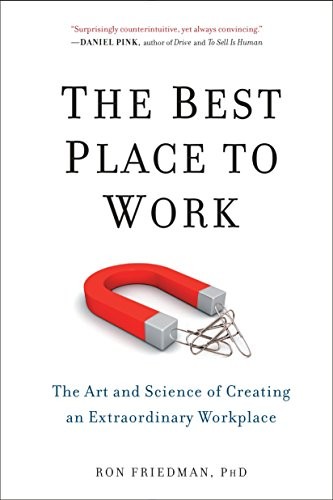
Talk to The Best Place to Work like its author wrote you back.
Get the ideas that fit your life — not generic summaries.
- Chat with the book
- Audiobook-style main ideas
- Adapts to your life and goals
- Helps you take action
What it argues
The Best Place to Work is Ron Friedman's survey of psychological and social science research on what actually makes workplaces effective. Friedman, a social psychologist, synthesizes findings from motivational psychology, cognitive science, social dynamics, and organizational behavior into practical recommendations for managers and leaders. The book covers a wide range of topics — physical space, feedback, intrinsic motivation, relationships, identity, and failure — with each chapter anchored to a specific research finding.
The central thesis is that most organizations design work for compliance rather than for human performance. Standard management practices — surveillance, performance pressure, micromanagement, reward systems tied purely to extrinsic outcomes — often produce the opposite of what they're meant to produce. Friedman's argument, drawn from decades of psychological research, is that human beings do their best work when they feel autonomous, competent, and connected to others who genuinely care about them.
What it gets right
- 1.
Intrinsic motivation — the drive that comes from finding work inherently interesting or meaningful — produces better performance, more creativity, and higher persistence than extrinsic rewards in most knowledge-work contexts.
- 2.
The three core human needs at work are autonomy (control over how you work), competence (the sense that you're growing and effective), and relatedness (genuine connection with colleagues). Environments that satisfy these needs consistently outperform those that don't.
- 3.
Psychological safety — the belief that you can speak up, take risks, and make mistakes without punishment — is one of the strongest predictors of team performance. Google's Project Aristotle confirmed this across their entire workforce.
What it covers
Who wrote it
Ron Friedman is a social psychologist and founder of ignite80, a research consultancy that helps organizations apply behavioral science to leadership and workplace design. He has written for Harvard Business Review, Psychology Today, and other publications. The Best Place to Work was his first major popular book and drew on his background in motivational and social psychology to synthesize academic research for a management audience. He speaks regularly to corporate and nonprofit audiences on evidence-based management.
