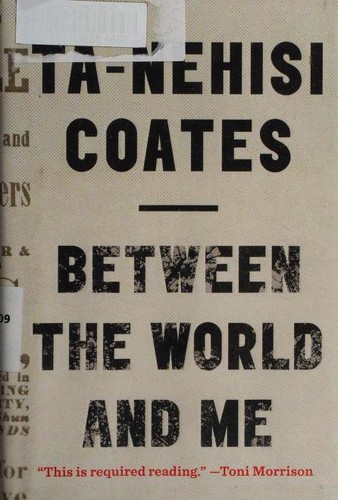
Talk to Between the World and Me like its author wrote you back.
Get the ideas that fit your life — not generic summaries.
- Chat with the book
- Audiobook-style main ideas
- Adapts to your life and goals
- Helps you take action
Between the World and Me, in detail
Between the World and Me is a letter from Ta-Nehisi Coates to his teenage son, Samori, about what it means to live in a Black body in the United States. Written in the tradition of James Baldwin's The Fire Next Time, the book works through history, memory, and fear to describe the particular vulnerability that shapes Black American life. Coates is not offering a program for change. He is trying to tell his son the truth about the country they both inhabit.
The organizing idea is the body. Coates returns to it throughout: the way American history has been built on the seizure and destruction of Black bodies, the way that fear for his son's body is inseparable from love for him, the way that any politics that ignores the physical stakes of race is incomplete. He draws on his childhood in West Baltimore, his years at Howard University among students who called themselves the Mecca, and the murder of his college friend Prince Jones by a police officer who was never charged. Jones's death is the emotional center of the book — a concrete instance of what abstraction tends to smooth over.
Coates does not offer the comfort that things are improving or that America will redeem itself. He is skeptical of "The Dream" — the story that Americans tell themselves about progress and exceptionalism — because that dream has historically required Black people to absorb its costs. He credits Toni Morrison, Howard, and the act of reading as the closest things to salvation he's found, not because they change the country's structure but because they give him a way to see it clearly and still act.
The book is short, around 150 pages, and dense with feeling. Its strength is its refusal to simplify. Coates does not pretend that knowing history makes the fear go away, or that love for his son is enough protection. For readers who have not thought deeply about race, it can be disorienting — by design. For readers who have, it may feel like the most honest account of a specific kind of exhaustion they've encountered in print.
The big ideas
- 1.
The destruction of the Black body — through slavery, mass incarceration, and police violence — is not an accident of American history but a recurring feature of how the country has been built and maintained.
- 2.
Coates frames fear as rational, not as a failure of courage. The fear a Black parent feels for their child is a response to documented, persistent danger, not a psychological problem to be overcome.
- 3.
"The Dream" — the optimistic, progress-oriented American self-image — has always been subsidized by the exploitation and erasure of people who were not allowed inside it.
