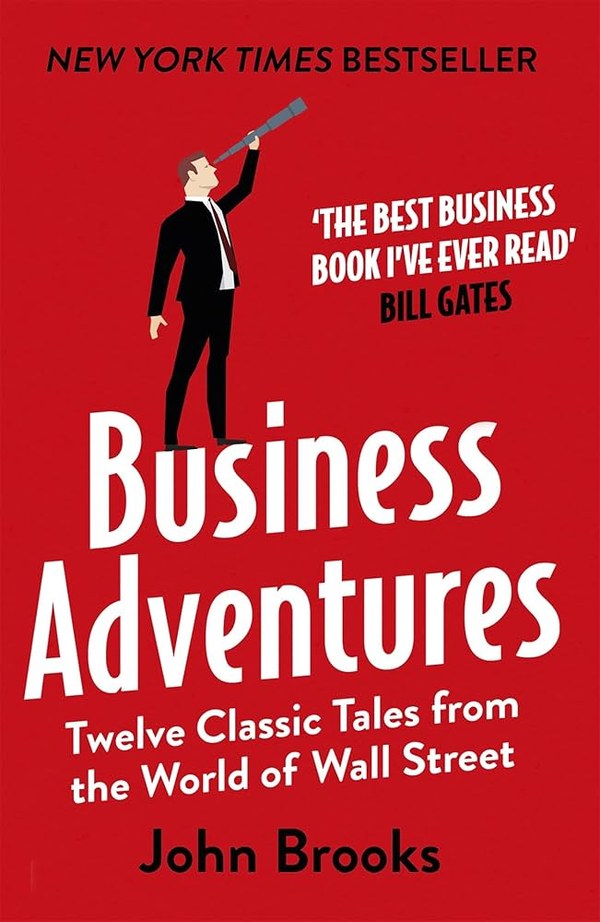
Talk to Business Adventures: Twelve Classic Tales from the World of Wall Street like its author wrote you back.
Get the ideas that fit your life — not generic summaries.
- Chat with the book
- Audiobook-style main ideas
- Adapts to your life and goals
- Helps you take action
Business Adventures: Twelve Classic Tales from the World of Wall Street, in detail
Business Adventures is a collection of twelve long-form New Yorker profiles originally published between 1959 and 1969. John Brooks covered business for the magazine for decades, and these pieces represent his best work: detailed, narratively rich accounts of corporate crises, market panics, tax battles, and the personalities behind major American enterprises of the postwar era. Bill Gates famously called it the best business book he had ever read; Warren Buffett gave Gates his copy. That recommendation put an out-of-print book back into circulation and earned it a new readership sixty years after its original publication.
The twelve stories span a remarkable range. The opening chapter reconstructs the stock market crash of 1962 — a sudden, inexplicable panic that temporarily wiped out enormous value and left traders and regulators bewildered. The chapter on the Ford Edsel is the definitive account of one of business history's most expensive failures, examining how a car designed by market research ended up rejected by the very market it was designed for. Other chapters cover Xerox's rise, the mechanics of the income tax, a price-fixing scandal in the electrical industry, and the founder of Piggly Wiggly's quixotic attempt to corner the market on his own stock.
What makes Brooks's writing unusual for its time and durable across decades is the psychological honesty. He is interested not just in what decisions were made but in the rationalizations, miscommunications, groupthink, and occasional spectacular misjudgments that shaped them. The Edsel chapter, for instance, reads as a case study in how organizations convince themselves that data supports what they have already decided to do. The stock market chapters capture the gap between financial models and actual human behavior under pressure.
The book has obvious limitations as a practical guide: it is nearly sixty years old, the companies and executives are historical, and the regulatory and market structures it describes have changed substantially. But as business literature — as writing about business with literary seriousness and psychological depth — it holds up better than most of what has been published since. Brooks demonstrated that corporate behavior was worth the same careful attention that writers gave to politics or culture, and the best chapters remain absorbing long after the facts in them have been superseded.
The big ideas
- 1.
Corporate culture and human psychology — not just strategy or market conditions — determine how organizations respond to crisis, and those responses are often irrational in predictable ways.
- 2.
The Edsel failure showed that market research, however extensive, cannot substitute for genuine customer insight: the car validated internal assumptions rather than uncovering real demand.
- 3.
Market panics can be self-reinforcing and disconnected from underlying fundamentals: the 1962 crash recovered quickly but revealed how fragile investor confidence is to crowd behavior.
