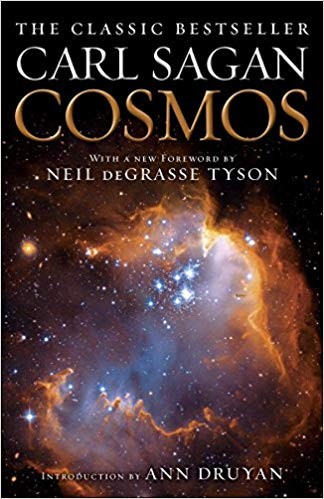
Talk to Cosmos like its author wrote you back.
Get the ideas that fit your life — not generic summaries.
- Chat with the book
- Audiobook-style main ideas
- Adapts to your life and goals
- Helps you take action
Cosmos, in detail
Cosmos is Carl Sagan's attempt to tell the full story of the universe and humanity's place in it — from the Big Bang to the origins of life to the rise of science as a way of knowing. It began as a companion to the 1980 PBS television series, but the book is richer and more personal than the show. Sagan moves fluidly between astrophysics, evolutionary biology, ancient history, and philosophy, treating them all as chapters in a single narrative about how matter became capable of contemplating itself.
The book's central argument is that science is not a collection of facts but a method — a way of not fooling yourself. Sagan traces that method from the ancient Greeks, particularly the astronomers of Alexandria who measured the Earth's circumference and proposed a heliocentric solar system, to Kepler and Newton, to the space missions of his own era. At each turn he shows what was at stake: not just knowledge, but the difference between a civilization that can confront reality and one that retreats into superstition. The destruction of the Library of Alexandria haunts the book as a symbol of how fragile accumulated knowledge can be.
Sagan is at his most compelling when he writes about scale. The Cosmic Calendar — compressing all of time from the Big Bang to the present into a single year — makes viscerally clear how recently humans arrived on the scene. We appear in the last few seconds of December 31st. All of recorded history fits in the final ten seconds. This technique of forcing the reader to feel the numbers, not just read them, is what separates Cosmos from a textbook. Sagan is also unusually honest about the limits of what we know. He lingers on the unsolved problems: the origin of life, the nature of consciousness, whether intelligence exists elsewhere in the universe.
The book has weaknesses. Some chapters on early Greek science slow the pace, and the optimism about humanity's capacity for reason can feel strained against the historical evidence Sagan himself cites. But Cosmos endures because it does something rare: it makes the universe feel both incomprehensibly vast and personally meaningful. Sagan's recurring phrase — that we are made of star-stuff — is not a metaphor. It is a literal description of stellar nucleosynthesis, and yet it also carries genuine emotional weight. Few science books manage both.
The big ideas
- 1.
The cosmos is about 13.8 billion years old. Compressing that span into a single year, all of human history fits inside the last ten seconds of December 31st.
- 2.
Science is a method for self-correction, not a set of conclusions. Its power comes from the willingness to discard ideas when evidence demands it.
- 3.
We are made of star-stuff. The atoms in your body were forged in the cores of stars that exploded before the solar system existed.
