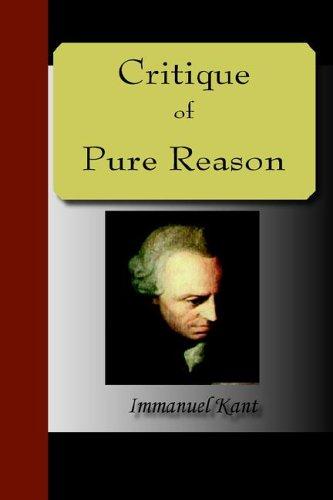
Talk to Critique of Pure Reason like its author wrote you back.
Get the ideas that fit your life — not generic summaries.
- Chat with the book
- Audiobook-style main ideas
- Adapts to your life and goals
- Helps you take action
What it argues
The Critique of Pure Reason is Kant's attempt to resolve a crisis in 18th-century philosophy by asking what human reason can and cannot know. The crisis had been produced by Hume's skepticism: if all knowledge comes from experience, then causal necessity, mathematical certainty, and metaphysical claims about God and the soul are all on shaky ground. Kant accepted Hume's challenge but rejected his conclusion. His solution was to invert the problem: instead of asking how the mind conforms to objects, ask how objects conform to the mind.
The first major section establishes that space and time are not features of the external world that we discover but forms of human intuition through which we organize experience. Everything we perceive is already structured spatially and temporally before any concept is applied. This is Kant's "transcendental aesthetic," and it grounds the possibility of mathematics: geometry is certain because it describes the structure of our perception, not contingent facts about the world.
What it gets right
- 1.
Space and time are not properties of things as they are in themselves but forms of human intuition — the structure through which we organize all experience.
- 2.
The mind does not passively receive the world; it actively shapes experience by applying categories like causality and substance to the raw material of sensation.
- 3.
The distinction between phenomena (things as they appear) and noumena (things as they are in themselves) defines the limit of possible human knowledge.
What it covers
Who wrote it
Immanuel Kant (1724–1804) was a German philosopher who spent almost his entire life in Königsberg, Prussia. He is considered the central figure of modern philosophy. His three major Critiques — of Pure Reason (1781), Practical Reason (1788), and Judgment (1790) — constitute one of the most systematic and influential achievements in the history of philosophy. His ethical theory, grounded in the categorical imperative, and his political philosophy, which prefigured liberal democratic theory, remain central to academic philosophy today.
