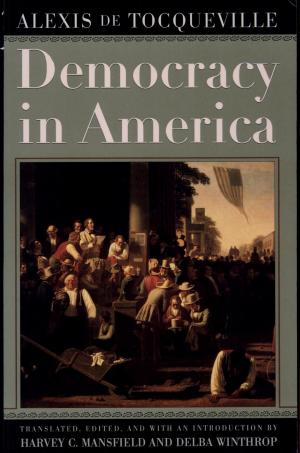
Talk to Democracy in America like its author wrote you back.
Get the ideas that fit your life — not generic summaries.
- Chat with the book
- Audiobook-style main ideas
- Adapts to your life and goals
- Helps you take action
What it argues
Democracy in America, published in two volumes in 1835 and 1840, is Alexis de Tocqueville's analysis of the democratic experiment in the United States as a model for what was coming to Europe. Tocqueville traveled through America in 1831 as a young French magistrate, ostensibly to study the prison system, and returned with observations that ranged from the structure of townships and courts to the psychology of democratic citizens and the long-term hazards of equality as a governing principle. He was not simply impressed; he was anxious, and the anxiety is what gives the work its lasting value.
Tocqueville's organizing concept is the equality of conditions — the social leveling he observed in America relative to the aristocratic Europe he knew. This equality was not just economic but psychological: it reshaped how people related to authority, how they formed associations, what they considered worthy of ambition, and how they understood the past. He saw it as an irreversible historical tendency, not a political choice, and his aim was to understand what kinds of government and culture it was compatible with.
What it gets right
- 1.
The equality of conditions is the foundational social fact of democratic societies, shaping psychology, ambition, and politics in ways that aristocratic societies cannot fully anticipate.
- 2.
The tyranny of the majority is a distinctive democratic danger: not physical coercion but the social pressure to conform to majoritarian opinion that makes dissent psychologically costly.
- 3.
Local self-governance — in Tocqueville's account, the New England township — functions as a school for civic life, training citizens in the habits of political participation that democracy requires.
What it covers
Who wrote it
Alexis Charles Henri Clérel de Tocqueville (1805–1859) was a French political thinker, historian, and statesman. He served as a magistrate and later as a member of the French legislative assembly and briefly as Foreign Minister under the Second Republic. Besides Democracy in America, his major work is The Old Regime and the Revolution, a historical analysis of the French Revolution's relationship to the Ancien Régime. Tocqueville is widely regarded as one of the founders of modern political sociology and one of the most perceptive analysts of democratic society ever to write.
