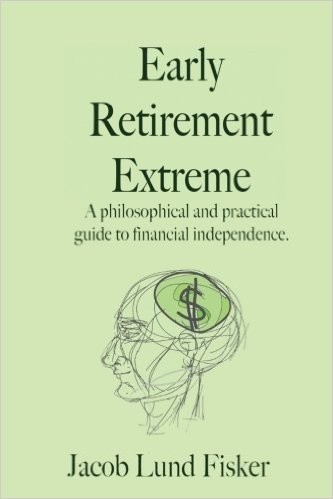
Talk to Early Retirement Extreme like its author wrote you back.
Get the ideas that fit your life — not generic summaries.
- Chat with the book
- Audiobook-style main ideas
- Adapts to your life and goals
- Helps you take action
What it argues
Early Retirement Extreme is Jacob Lund Fisker's book-length argument for a radically different relationship with money, work, and consumption. Fisker, a Danish physicist who retired in his early thirties after five years of extreme frugality and saving, frames conventional modern life — college, career, mortgage, consumer spending, retirement at 65 — as a system that most people accept without questioning its premises. He offers an alternative system based on Renaissance-man competence, dramatically reduced consumption, and investment income replacing wage income within five to ten years.
The book is more philosophical and systems-oriented than most personal finance writing. Fisker draws on ecological thinking, philosophy, game theory, and engineering to build a critique of the "salary man" model and a positive case for what he calls the Renaissance ideal: a person capable of performing many roles, consuming little, producing much, and depending minimally on external systems. He argues that competence — in cooking, repair, health, financial management, gardening — is a better buffer against life's uncertainties than money alone, and that consuming professionally provided services is not just expensive but atrophying.
What it gets right
- 1.
Savings rate, not income level, determines how many years of work financial independence requires. Moving from a 10% to a 50% savings rate roughly halves the timeline.
- 2.
Competence in many domains — cooking, repair, health management, finance — is both cheaper than outsourcing and more resilient than pure financial wealth.
- 3.
Conventional modern life is a system with specific tradeoffs, not a default. Accepting it without examining its premises is a choice, even if it doesn't feel like one.
What it covers
Who wrote it
Jacob Lund Fisker is a Danish physicist who achieved financial independence in his early thirties after five years of working in the United States and saving at an extreme rate. He founded the Early Retirement Extreme blog in 2007 and published the book version in 2010, several years before the FIRE movement achieved mainstream visibility. He holds a PhD in astrophysics from the University of Aarhus. After retiring he returned to work as a quantitative trader, a decision he discusses as consistent with the book's framework rather than a contradiction of it. He approaches personal finance with the same rigor he applied to physics.
