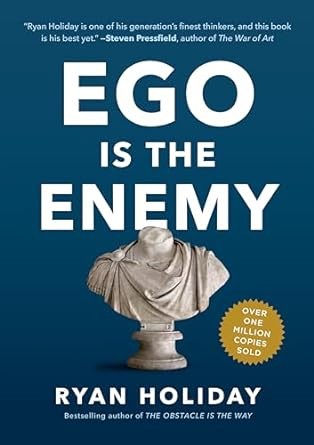
Talk to Ego Is the Enemy like its author wrote you back.
Get the ideas that fit your life — not generic summaries.
- Chat with the book
- Audiobook-style main ideas
- Adapts to your life and goals
- Helps you take action
Ego Is the Enemy, in detail
Ego Is the Enemy is Ryan Holiday's argument that ego — the inflated sense of our own importance, the need to be seen and validated — is the most consistent obstacle to doing meaningful work and living well. Holiday draws on Stoic philosophy, military history, and biography to make the case that ego sabotages us at every stage: when we're starting out and ambition shades into entitlement, when we're succeeding and confidence curdles into arrogance, and when we're failing and pride prevents honest reckoning.
The book is organized around three phases rather than a linear self-help ladder. In the aspiring phase, Holiday argues that talking about what we're going to do is often a substitute for doing it — the approval we get from announcing a plan partially satisfies the same drive that should be pushing us to execute. The work itself, done quietly and without audience, is where real skill accumulates. He draws on figures like Katharine Graham, who spent years in self-effacing roles before leading the Washington Post through its most consequential decades.
In the succeeding phase, the danger shifts. Success provides evidence for whatever story ego wants to tell, and the story is usually wrong. Holiday points to figures like Howard Hughes and William Sherman to show how differently people handle the same external recognition: some use it as fuel and calibration; others let it become their identity, and then defend the identity rather than do the work. The chapter on "entitlement, control, and paranoia" tracks how capable people become destructive once they believe their success was inevitable and their judgment infallible.
In the failing phase — which Holiday treats as inevitable for anyone who attempts anything serious — ego's damage is subtler. Failure requires honest self-examination, and ego makes that almost unbearably uncomfortable. The people who recover are usually the ones who can separate what happened from who they are. Holiday's prescription is less motivational than structural: find work you believe in independent of recognition, build the habit of learning over the habit of performing, and keep a beginner's sense of how much remains unknown. The writing is spare and the historical examples are well-chosen. Readers who want step-by-step tactics will find Holiday's approach more philosophical than practical, but the diagnosis is precise and often uncomfortably accurate.
The big ideas
- 1.
Ego is not confidence or ambition — it is the voice that tells you results already owed to you, that recognition matters more than the work itself.
- 2.
Talking about what you plan to do provides a psychological reward similar to actually doing it, which is why ambitious people often announce rather than execute.
- 3.
In the aspiring phase, the most dangerous habit is performing work rather than doing it — optimizing for how you look to others while the real craft goes undeveloped.
