Talk to Essays and Aphorisms like its author wrote you back.
Get the ideas that fit your life — not generic summaries.
- Chat with the book
- Audiobook-style main ideas
- Adapts to your life and goals
- Helps you take action
What it argues
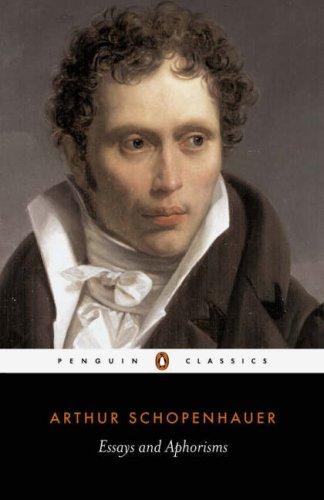
Essays and Aphorisms is R. J. Hollingdale's selection from Schopenhauer's Parerga and Paralipomena — the supplementary essays he published in 1851, which paradoxically became the work that finally brought him fame after decades of neglect. The aphorisms and essays cover an enormous range: on the sufferings of the world, on the wisdom of life, on religion, on women, on books and writing, on noise, on genius, on the vanity of human desire. The tone ranges from bleakly lucid to occasionally cantankerous, but consistently bears the mark of a writer who has thought about what he is saying rather than simply repeating convention.
Schopenhauer's philosophy rests on the claim that the fundamental reality underlying all phenomena — including the human organism — is will: a blind, purposeless, insatiable striving that is never satisfied and produces suffering as its inevitable byproduct. The individual will desires, achieves briefly, and immediately desires again. Boredom fills the gaps between desires; pain fills the failures; and the brief satisfactions merely clear the way for more wanting. This is not temporary or accidental but the structure of existence itself.
What it gets right
- 1.
The fundamental reality is will — blind, purposeless, insatiable striving — and suffering is its inevitable product rather than an accident to be fixed.
- 2.
Every desire satisfied produces only a brief pause before new desire arises; life oscillates between suffering (unsatisfied desire) and boredom (emptied desire).
- 3.
Genuine wisdom pursues the minimization of pain rather than the maximization of pleasure, since the latter is always transient and the former is more reliably within reach.
What it covers
Who wrote it
Arthur Schopenhauer (1788–1860) was a German philosopher who developed a metaphysical system in which the fundamental reality underlying all phenomena is a blind, purposeless will, generating suffering as its inevitable product. His major work, The World as Will and Representation (1818), was largely ignored for decades, but his Parerga and Paralipomena (1851) — the source of these essays — brought him late fame. He was a significant influence on Nietzsche, Wagner, Freud, and many 20th-century writers. He lived as a comfortable bachelor in Frankfurt for the second half of his life, supported by his inheritance and attended by a succession of poodles.
