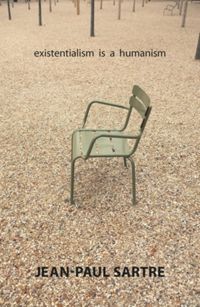
Talk to Existentialism Is a Humanism like its author wrote you back.
Get the ideas that fit your life — not generic summaries.
- Chat with the book
- Audiobook-style main ideas
- Adapts to your life and goals
- Helps you take action
What it argues
Existentialism Is a Humanism began as a 1945 lecture Sartre gave to a packed Paris hall in response to critics who called existentialism pessimistic, quietist, and dangerous. The text is Sartre's most accessible statement of his philosophy — short, clear, and rhetorically sharp in a way that Being and Nothingness never is. He was later ambivalent about it, feeling it oversimplified his position, but it remains the standard entry point into existentialist thought.
The core argument turns on three formulations. First, existence precedes essence: for human beings, unlike artifacts designed before they are made, there is no pre-given nature or purpose. We exist first, then create ourselves through choice. Second, because there is no fixed human nature and no God to provide a blueprint, radical freedom is not optional — we are fully responsible for what we become. Third, this responsibility extends beyond the individual: in choosing for yourself, you implicitly choose for all of humanity, because you are affirming a vision of what humans should be. Bad faith — the refusal to own this responsibility — is always possible but never exculpatory.
What it gets right
- 1.
Existence precedes essence: humans have no pre-given nature or purpose; we create ourselves through our choices.
- 2.
Radical freedom is inescapable — not choosing is itself a choice, and every choice is fully our own responsibility.
- 3.
In choosing for ourselves, we implicitly affirm a vision of what humans ought to be, making our choices a kind of universal legislation.
What it covers
Who wrote it
Jean-Paul Sartre (1905–1980) was a French philosopher, novelist, and playwright who became the defining figure of French existentialism. His major philosophical works include Being and Nothingness and Critique of Dialectical Reason; his literary works include the novel Nausea and the play No Exit. He declined the Nobel Prize in Literature in 1964, citing his refusal to be institutionalized by any establishment. His lifelong intellectual partnership with Simone de Beauvoir produced one of the most discussed intellectual relationships of the 20th century.
