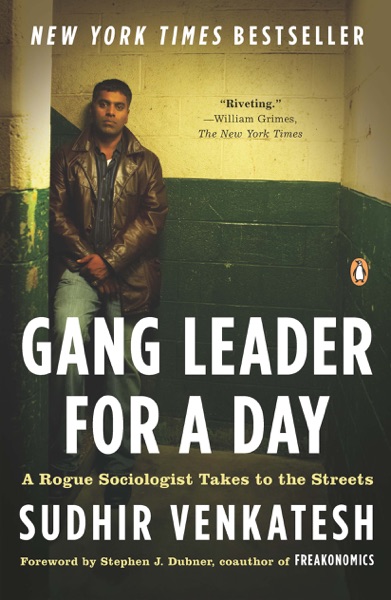
Talk to Gang Leader for a Day like its author wrote you back.
Get the ideas that fit your life — not generic summaries.
- Chat with the book
- Audiobook-style main ideas
- Adapts to your life and goals
- Helps you take action
Gang Leader for a Day, in detail
Gang Leader for a Day is Sudhir Venkatesh's account of the decade he spent doing ethnographic fieldwork in the Robert Taylor Homes, a Chicago public housing project, beginning in the late 1980s. He arrived as a first-year sociology graduate student, clipboard in hand, intending to administer a survey. He met J.T., the leader of a Black Kings gang faction who controlled several high-rise buildings, and stayed — returning again and again over nearly a decade — as an embedded observer of one of the most concentrated poverty environments in American urban history.
The book describes how J.T.'s gang actually functioned: not as a chaotic criminal enterprise but as a quasi-governmental structure that collected revenue, settled disputes, provided security, employed residents, and managed relationships with city agencies and local politicians. In the absence of functioning public institutions, the gang filled the institutional vacuum. This doesn't make the violence or the exploitation less real — Venkatesh is clear about both — but it complicates the picture that outsiders, including most policy makers, have of how such communities are organized.
The ethical dimensions of the research are the book's most uncomfortable thread. Venkatesh gradually became something more than an observer: he witnessed crimes, was present during violence, accepted money, and played an active role in some of the situations he was nominally studying. The "gang leader for a day" of the title refers to a half-comic, half-serious episode in which J.T. invited Venkatesh to run the organization for a day as a learning exercise. The episode illuminates both the appeal and the moral cost of deep ethnographic immersion: the closer Venkatesh got to understanding the community, the more compromised his position became.
Gang Leader for a Day is one of the more vivid and readable works of urban sociology produced in recent decades. It is honest about its own methods in ways that academic sociology rarely is, and it makes visible a social world that most Americans encounter only through crime statistics. The questions it raises about what it means to research poverty from the outside — who benefits, who is exposed, what the researcher owes the community — remain genuinely unresolved.
The big ideas
- 1.
Urban gangs in concentrated poverty environments often function as quasi-governmental structures, filling institutional vacuums left by absent or dysfunctional public services and policing.
- 2.
J.T.'s gang had internal hierarchy, employment structures, dispute resolution mechanisms, and relationships with city institutions. Understanding this complexity is necessary for any policy that aims to change it.
- 3.
The Robert Taylor Homes were a product of deliberate policy choices — concentrated, high-density public housing isolated from the rest of the city — and their social pathologies were structurally produced, not innate.
