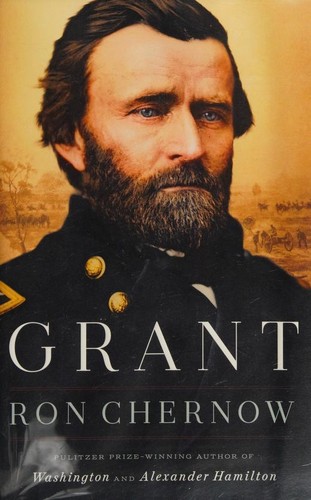
Talk to Grant like its author wrote you back.
Get the ideas that fit your life — not generic summaries.
- Chat with the book
- Audiobook-style main ideas
- Adapts to your life and goals
- Helps you take action
Grant, in detail
Ron Chernow's biography of Ulysses S. Grant is a comprehensive rehabilitation of a man whose reputation has been shaped for a century by Lost Cause mythology — the Southern-generated narrative that dismissed Grant as a butcher whose only military advantage was a willingness to sacrifice lives, and whose presidency was a corrupt failure. Chernow's documented argument is more complicated and considerably more sympathetic: Grant was a military genius, a man of genuine moral courage on the question of race and Reconstruction, and a president whose administration was damaged by subordinates he trusted too freely but whose commitment to Black Americans' civil rights was the most serious of any nineteenth-century president except Lincoln.
The early biography is the story of a failure. Grant was a decorated Mexican War officer who, after being stationed at a miserable post in California far from his wife, developed a serious drinking problem, resigned his commission under pressure, and spent the 1850s failing at farming, firewood selling, and real estate. He was thirty-eight years old, broke, and working as a clerk in his brothers' leather goods store in Galena, Illinois when the Civil War began and offered him a second chance.
The war sections are the biographical core. Chernow traces Grant's transformation from a captain commanding a volunteer regiment in Missouri to the general who forced the first major Union victories (Forts Henry and Donelson), who won Shiloh despite near-disaster, who conducted the brilliant Vicksburg campaign that split the Confederacy, and who managed the final grinding campaigns in Virginia that ended the war. Chernow is detailed on the military strategy and consistently places Grant's choices in the context of the political pressures, the available forces, and the alternative decisions that other generals were making simultaneously.
The presidential chapters are the biography's most revisionary. Grant presided over Reconstruction with genuine commitment to Black civil rights — his administration prosecuted the Ku Klux Klan, created the Justice Department specifically to enforce civil rights laws, and stood against the Democratic Party's violent suppression of Black political participation. His failures were real: the corruption scandals of the second term, the Whiskey Ring, the Credit Mobilier, the appointments of men who proved dishonest. But Chernow argues these failures have been used to delegitimize an administration whose most important achievement — the partial enforcement of the Fourteenth and Fifteenth Amendments — was deliberately dismantled after his departure.
The big ideas
- 1.
Grant's military reputation was deliberately degraded by Lost Cause writers who needed to explain the Confederacy's defeat without crediting Union superiority. Chernow documents this campaign of revisionism.
- 2.
Alcoholism in the nineteenth century was not understood as a disease. Grant's drinking was episodic rather than continuous — he drank heavily during certain periods, not during campaigns — and its actual effect on his military performance is more ambiguous than the mythology suggests.
- 3.
The Vicksburg campaign, which Grant designed and executed independently, is one of the most brilliant in American military history. Its success depended on a strategic improvisation that broke the conventional rules of campaigning.
