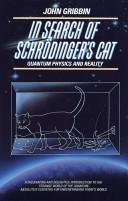
Talk to In Search of Schrödinger's Cat like its author wrote you back.
Get the ideas that fit your life — not generic summaries.
- Chat with the book
- Audiobook-style main ideas
- Adapts to your life and goals
- Helps you take action
In Search of Schrödinger's Cat, in detail
John Gribbin's 1984 book remains one of the most thorough popular introductions to quantum mechanics ever written. Gribbin, an astrophysicist and prolific science writer, traces the historical development of quantum theory from Planck's quantum hypothesis through Einstein, Bohr, Heisenberg, Schrödinger, Dirac, and into the interpretive debates of the mid-twentieth century. The result is a book that treats quantum mechanics as both a scientific theory and a philosophical puzzle that physicists themselves have never fully agreed on how to interpret.
The first half of the book is largely historical. Gribbin shows how classical physics broke down in the face of blackbody radiation, the photoelectric effect, and atomic spectra, forcing physicists to accept that energy comes in discrete packets and that light behaves as both a wave and a particle. This isn't background-setting: Gribbin conveys genuine intellectual drama in the discovery that nature doesn't work the way anyone expected it to.
The second half engages the measurement problem and the competing interpretations: Copenhagen, many-worlds, and others. The famous cat thought experiment — designed by Schrödinger to expose what he saw as an absurdity in the Copenhagen interpretation — gives the book its title and its sharpest question. If quantum superposition applies everywhere, what happens when a quantum event is linked to the life or death of a cat? Is the cat really both alive and dead until observed? Gribbin treats this seriously and surveys the various answers physicists and philosophers have proposed.
The book is longer and more demanding than typical popular physics, which is both its strength and its limitation. Gribbin doesn't smooth over hard ideas. Readers who engage carefully will come away with a genuine sense of why quantum mechanics is philosophically disturbing, not just abstractly strange. Those who want a quick tour should look elsewhere, but for readers willing to spend time with the ideas, it holds up remarkably well despite being four decades old.
The big ideas
- 1.
Quantum mechanics emerged from a series of crises in classical physics that no existing theory could resolve. The quantum was a reluctant invention, not an enthusiastic one.
- 2.
Wave-particle duality is not a paradox to be resolved but a feature of nature: quantum objects exhibit wave or particle behavior depending on how they are observed.
- 3.
Heisenberg's uncertainty principle is fundamental. The position and momentum of a particle cannot both be precisely known simultaneously, not because of measurement limitations but by physical law.
