Talk to Intuitive Eating like its author wrote you back.
Get the ideas that fit your life — not generic summaries.
- Chat with the book
- Audiobook-style main ideas
- Adapts to your life and goals
- Helps you take action
Intuitive Eating, in detail
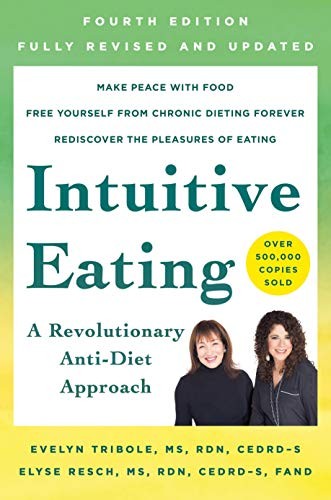
Intuitive Eating, first published in 1995 and now in its fourth edition, is registered dietitian Evelyn Tribole's framework for disengaging from diet culture and relearning to eat in response to hunger and satiety rather than external rules. Co-authored with dietitian Elyse Resch, the book argues that the diet industry has produced a population of people who are systematically disconnected from their body's signals about food — good eaters in childhood who have been taught, through decades of dieting, to distrust their own experience.
The framework consists of ten principles, each targeting a different way that diet culture interferes with natural eating. The first principle is rejecting the diet mentality — acknowledging that diets fail long-term for most people and that the promise of a perfect body through the right program is a commercial proposition rather than a medical one. From there, the principles move through honoring hunger (eating before it becomes desperate), making peace with food (removing forbidden categories that create binge cycles), challenging the food police (the internalized voice that judges every eating decision), and feeling your fullness.
Later principles address emotional eating, body respect, and movement for pleasure rather than punishment. Tribole and Resch are careful to distinguish intuitive eating from unrestricted eating — the goal is not to eat whatever you want in whatever quantity but to restore a natural regulatory relationship with food that most people had as young children and lost through dieting. The research section of the book documents associations between intuitive eating and improved psychological wellbeing, reduced binge eating, and more stable weight over time compared to restrained eating.
Intuitive eating has become more prominent in recent years as the Health at Every Size movement has grown. The book is sometimes caricatured as anti-health or as permission to eat unhealthily. The actual framework is more nuanced — it does not dismiss the relationship between food and health but argues that obsessive focus on dietary rules undermines both mental and physical health, and that trust in bodily cues is a more durable foundation for healthy eating than compliance with external prescriptions.
The big ideas
- 1.
Chronic dieting systematically disconnects people from hunger and satiety signals, making it harder to eat in response to genuine physiological need.
- 2.
The restrict-binge cycle is a predictable psychological response to food restriction: forbidden foods become more appealing, restriction eventually fails, overconsumption follows, guilt triggers new restriction.
- 3.
Making all foods permissible reduces their psychological power; people who don't restrict specific foods typically eat those foods in more moderate quantities than people who periodically break their restrictions.
