Talk to Just Keep Buying like its author wrote you back.
Get the ideas that fit your life — not generic summaries.
- Chat with the book
- Audiobook-style main ideas
- Adapts to your life and goals
- Helps you take action
Just Keep Buying, in detail
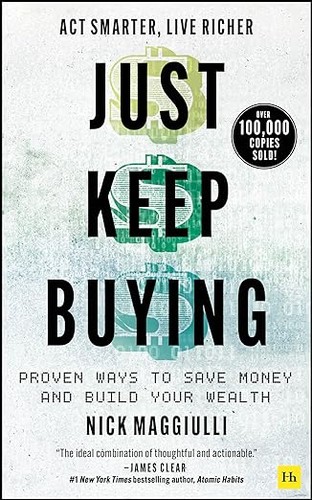
Just Keep Buying is Nick Maggiulli's data-driven answer to the two central questions of personal finance: how much should you save, and how should you invest it? Maggiulli is a data scientist who runs the Of Dollars and Data blog, and the book reflects his background — it is organized around empirical research and historical data rather than anecdote and conventional wisdom. His title reflects his primary investment conclusion: for most investors, the best strategy is to keep buying broadly diversified assets consistently, regardless of market conditions.
Maggiulli opens by challenging the conventional wisdom that you can always save more. His analysis of income distributions suggests that for lower and middle income people, the binding constraint on wealth is income, not spending. The savings rate advice of most personal finance — save 20 percent, save 30 percent — assumes you have discretionary income to redirect. Many people don't. The implication is that for those people, increasing income is more impactful than reducing spending, and the book adjusts its advice accordingly.
The investment section builds the empirical case for consistent buying of diversified assets regardless of market conditions. Maggiulli analyzes lump-sum investing versus dollar-cost averaging, timing the market versus time in the market, and various "buy the dip" strategies versus consistent buying. His conclusion is that the evidence favors consistent buying because market timing attempts almost always leave investors worse off than steady accumulation. He also addresses how much to hold in cash, when to pay off debt versus invest, and how to think about retirement income.
The behavioral sections address the emotional dimensions: why investors sell at market bottoms, why comparison to others is financially destructive, how to handle lifestyle inflation, and how to frame investment losses to maintain discipline. Maggiulli writes with academic rigor but accessible prose, and the book's data-heavy approach distinguishes it from books that rely primarily on narrative and principle. For readers who want to understand why standard advice works before following it, or who have been given conflicting advice and want to see the empirical case, this is one of the more useful contemporary personal finance books.
The big ideas
- 1.
For lower and middle income people, increasing income matters more than reducing spending. The savings rate advice that dominates personal finance assumes discretionary income that many don't have.
- 2.
Consistent investing beats market timing in most historical scenarios. Just keep buying, regardless of market conditions, rather than waiting for the 'right' time to invest.
- 3.
Lump-sum investing outperforms dollar-cost averaging about two-thirds of the time, but dollar-cost averaging is easier to stick with behaviorally. Both beat not investing.
