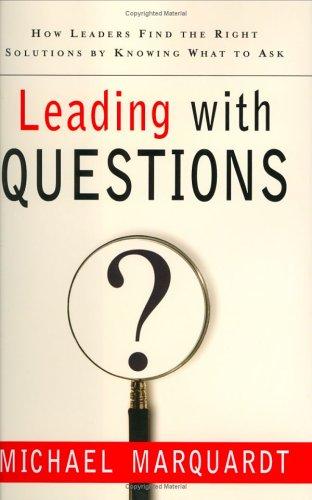
Talk to Leading with Questions like its author wrote you back.
Get the ideas that fit your life — not generic summaries.
- Chat with the book
- Audiobook-style main ideas
- Adapts to your life and goals
- Helps you take action
What it argues
Leading with Questions is Michael Marquardt's argument that great leaders are not distinguished by the quality of their answers but by the quality of their questions. Marquardt, a professor of human resource development and the founder of the World Institute for Action Learning, draws on interviews with leaders across business, government, and non-profits to make the case that leaders who habitually ask rather than tell create faster-learning, more engaged, more accountable organizations.
The central idea is simple and resists most objections: the person who asks a question controls the conversation more effectively than the person who answers one. Questions transfer ownership of a problem to the person being asked, which builds autonomy, accountability, and capacity. Leaders who answer every question train their teams to stop thinking. Leaders who reflect questions back — "What do you think we should do?" — train their teams to develop judgment. Marquardt categorizes questions by type: open vs. closed, affirmative vs. critical, hypothetical vs. grounded. He shows which types are most generative in which situations.
What it gets right
- 1.
Leaders who ask questions rather than give answers build teams that can think for themselves — which is what scales, while expert dependence does not.
- 2.
Questions transfer ownership. When a leader asks 'What do you think we should do?', the subordinate becomes an agent rather than an order-follower.
- 3.
Most leaders were promoted for having answers. That history creates a bias toward telling that must be actively countered through deliberate questioning habits.
What it covers
Who wrote it
Michael J. Marquardt is professor emeritus of human resource development at George Washington University and founder of the World Institute for Action Learning. He is the author of more than twenty books on leadership, organizational learning, and action learning, including Building the Learning Organization and Action Learning in Action. His work has been applied in organizations across more than a hundred countries. He is recognized as one of the leading authorities on action learning, a method of problem-solving and leadership development through iterative questioning and reflection.
