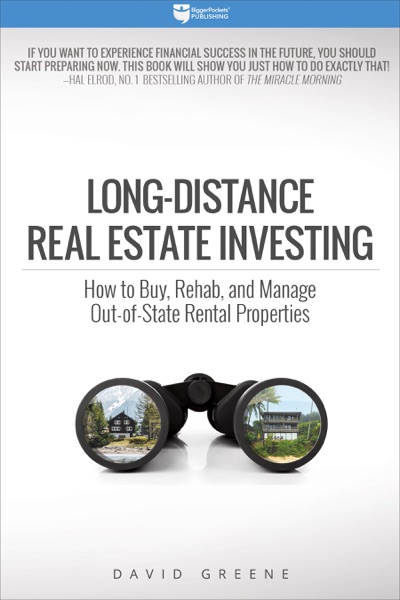
Talk to Long-Distance Real Estate Investing like its author wrote you back.
Get the ideas that fit your life — not generic summaries.
- Chat with the book
- Audiobook-style main ideas
- Adapts to your life and goals
- Helps you take action
Long-Distance Real Estate Investing, in detail
Long-Distance Real Estate Investing challenges one of the most persistent pieces of conventional real estate wisdom: that you should only buy in your own backyard. David Greene argues that limiting yourself to your local market often means overpaying for properties in expensive cities, settling for poor cash flow, or simply never starting because the numbers don't work where you live. The alternative is to invest in markets where the fundamentals are better, even if that means managing properties from hundreds or thousands of miles away.
The core of Greene's argument is that the modern tools available to investors — virtual tours, video calls, market data platforms, electronic document signing — have made long-distance management far more feasible than it was twenty years ago. The critical constraint is no longer proximity. It's the quality of your team: a reliable property manager, an experienced local agent who understands investor priorities, and a contractor whose estimates can be trusted. Greene devotes substantial attention to how to find, vet, and maintain relationships with each of these people.
The book walks through a disciplined process for selecting target markets. Greene looks at population growth, job market diversity, landlord-tenant law, price-to-rent ratios, and neighborhood-level indicators. He is direct about the difference between a market that feels safe because it's familiar and one that actually produces better risk-adjusted returns. The due diligence sections cover how to evaluate a property without walking through it, including how to interpret photos, identify red flags in inspection reports, and price repairs accurately from a distance.
Greene's writing is practical and experience-based. He's made the mistakes he warns against, and the book is better for it. Long-distance investing is not passive: it requires more careful systems and a higher tolerance for uncertainty upfront. But Greene makes a credible case that with the right team and processes in place, an out-of-state rental portfolio can be more profitable and less stressful than a local one built under worse market conditions.
The big ideas
- 1.
Your local market may not be the best market for your investment goals. Geographic loyalty costs money when better fundamentals exist elsewhere.
- 2.
The quality of your local team — property manager, agent, contractor — determines almost everything about how a long-distance investment performs.
- 3.
Market selection should be driven by data: job growth, population trends, landlord-tenant law, and price-to-rent ratios. Familiarity is not a criterion.
