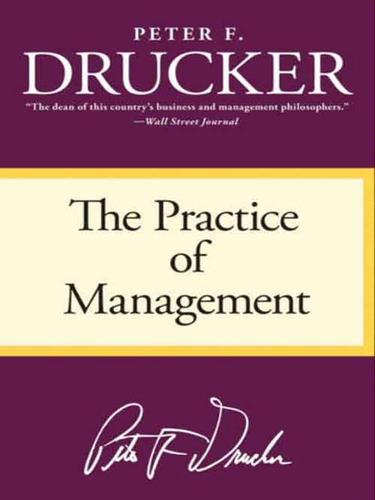
Talk to Management like its author wrote you back.
Get the ideas that fit your life — not generic summaries.
- Chat with the book
- Audiobook-style main ideas
- Adapts to your life and goals
- Helps you take action
Management, in detail
Management is Peter Drucker's most comprehensive statement on what managers do, why organizations exist, and what separates effective management from the appearance of it. First published in 1973 and revised in 2008, it synthesizes decades of Drucker's observation of businesses, hospitals, nonprofits, and government agencies into a unified theory of management as a practice — not a talent, not a personality trait, but a set of learnable disciplines applied with judgment.
Drucker's central argument is that the manager's job is to make organizations perform. That performance has three dimensions: making the specific institution (a business, a hospital, a school) perform its function; making work productive and workers achieve; and managing the social impacts of the institution on the communities around it. He insists throughout that these aren't separate ethical add-ons but are integral to what good management actually is. A manager who produces results today by destroying the institution's capacity to perform tomorrow isn't doing the job.
The book covers an enormous range: setting objectives and measuring results, organizing work, managing knowledge workers, handling innovation, understanding the relationship between strategy and structure, and running meetings. Drucker's insistence that knowledge workers cannot be managed the same way as industrial workers — that they must be treated as assets, not costs — was prescient in 1973 and has become even more relevant since. His treatment of decentralization, profit centers, and what he calls "the spirit of performance" anticipates debates that would occupy management theorists for decades.
At nearly 600 pages in its revised form, Management is not casual reading. It rewards study more than cover-to-cover consumption. Drucker's voice is authoritative without being imperious, and his case studies range from General Motors and Sears to the German Wehrmacht and the Roman Catholic Church. The breadth is deliberate: Drucker believed that management is the central institution of modern society, shaping human achievement more broadly than any other discipline, and he wrote with that weight of conviction throughout.
The big ideas
- 1.
Management is a practice, not a science or an art. It requires judgment applied to specific situations, not the mechanical application of principles.
- 2.
The purpose of a business is to create a customer. Profit is not the goal but the constraint — the minimum needed to survive and invest in the future.
- 3.
Managers have three jobs: making the institution perform, making work productive and workers achieving, and managing the institution's social impacts.
