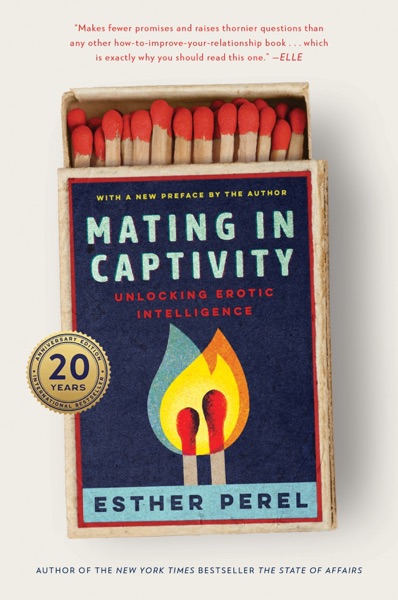
Talk to Mating in Captivity: Unlocking Erotic Intelligence like its author wrote you back.
Get the ideas that fit your life — not generic summaries.
- Chat with the book
- Audiobook-style main ideas
- Adapts to your life and goals
- Helps you take action
What it argues
Mating in Captivity is Esther Perel's examination of a paradox at the center of modern long-term relationships: the very things that create closeness and security — familiarity, predictability, mutual care — tend to undermine erotic desire. Perel, a Belgian psychotherapist who practices in New York and draws on clients from across dozens of cultures, argues that this is not a failure of the relationship but a structural tension that can be understood and navigated rather than simply endured.
Perel's central distinction is between love and desire. Love, she argues, seeks closeness, security, and continuity. Desire seeks distance, mystery, and novelty. The two are not opposites but they are in permanent tension. Modern relationships ask love and desire to coexist within the same partnership in ways that were historically unusual — a combination that creates both extraordinary intimacy and extraordinary erotic difficulty. Perel is not offering a workaround but a reframe: the tension is inherent, and acknowledging it honestly is the first step toward working with it.
What it gets right
- 1.
Love and desire are distinct drives that often work against each other. Love seeks closeness; desire requires some element of distance, mystery, or otherness.
- 2.
Modern relationships ask more of their partners than historical ones: they must be best friend, lover, co-parent, and spiritual companion simultaneously. That combination creates enormous intimacy and significant erotic strain.
- 3.
Familiarity and security, which are fundamental to a loving relationship, tend to reduce erotic tension. This is not a failure but a structural feature of long-term partnership.
What it covers
Who wrote it
Esther Perel is a Belgian psychotherapist based in New York City who practices couples and family therapy and is known for her work on erotic desire, the complexities of modern relationships, and the intersection of cultural identity and intimate life. She was born in Antwerp to Holocaust survivors, and her multicultural upbringing informs her work on how different cultural frameworks shape erotic and relational life. Mating in Captivity, published in 2006, became an international bestseller. Her subsequent book, The State of Affairs (2017), addressed infidelity with the same candor, and her podcast "Where Should We Begin?" has brought her practice to a wide audience.
