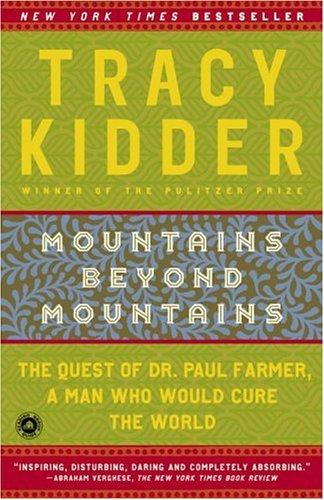
Talk to Mountains Beyond Mountains like its author wrote you back.
Get the ideas that fit your life — not generic summaries.
- Chat with the book
- Audiobook-style main ideas
- Adapts to your life and goals
- Helps you take action
What it argues
Tracy Kidder's portrait of Paul Farmer — the physician and anthropologist who co-founded Partners in Health and spent decades treating tuberculosis, AIDS, and cholera in rural Haiti and among the poorest communities of the world — is one of the most compelling biographies of a contemporary American figure. Kidder followed Farmer for years, accompanying him to Haiti, Russia, and Cuba, and the book captures both the practical details of his medicine and the philosophical framework that has made him one of the most influential figures in global health.
Farmer grew up in unusual poverty for a Harvard-educated doctor — his family lived for a time on a bus and later on a houseboat — and the early chapters trace the formation of his worldview in that peripatetic childhood. He went to Duke on scholarship, was drawn to Haiti through an encounter with Haitian migrant farmworkers as a student, and arrived in Cange, a desperately poor settlement in Haiti's Central Plateau, as a young medical student. He never really left. The Zanmi Lasante clinic he built there, and the Partners in Health organization it spawned, became the institutional expression of his conviction that the poor deserved the same quality of medical care as the rich.
What it gets right
- 1.
Farmer's foundational conviction: if the rich can receive effective treatment for tuberculosis, AIDS, and cholera, then withholding that treatment from the poor is a political choice, not a medical necessity.
- 2.
Social determinants of health are not background conditions; they are proximate causes. Farmer's work treats poverty, housing, nutrition, and social support as medical problems, not as obstacles to medicine.
- 3.
Global health requires solving logistics problems that have nothing to do with medicine. Getting medication to a patient in rural Haiti requires solving transport, food security, and community trust before the prescription matters.
What it covers
Who wrote it
Tracy Kidder is an American journalist and author who is one of the leading practitioners of literary nonfiction. His earlier book The Soul of a New Machine won both the Pulitzer Prize and the National Book Award in 1982. He has written about home construction, education, aging, and global medicine with equal depth and care. Mountains Beyond Mountains, published in 2003, was a finalist for the National Book Critics Circle Award and is widely used in medical school and public health curricula. He has continued to follow Paul Farmer's work in subsequent journalism.
