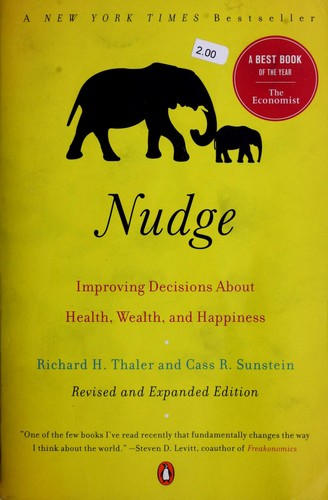
Talk to Nudge: Improving Decisions About Health, Wealth, and Happiness like its author wrote you back.
Get the ideas that fit your life — not generic summaries.
- Chat with the book
- Audiobook-style main ideas
- Adapts to your life and goals
- Helps you take action
What it argues
Nudge is Richard Thaler and Cass Sunstein's argument that the way choices are presented — the default option, the order of items, the framing of a question — powerfully shapes what people decide, often more than their own stated preferences. The authors call this the choice architecture, and they argue that because it always exists, there is no neutral design. Someone is always arranging the cafeteria, setting the default on the retirement form, deciding whether organ donation requires opt-in or opt-out. The question is whether that arrangement is thoughtful or accidental.
The book's central concept is the nudge: a change to the choice environment that steers people toward better outcomes without restricting their freedom to choose differently. Thaler and Sunstein call their framework "libertarian paternalism" — libertarian because it preserves free choice, paternalistic because it acknowledges that people often make decisions that don't serve their own interests. The most powerful example in the book is retirement savings. When enrollment in a 401(k) plan requires active sign-up, participation rates are low. When it becomes the default and employees must opt out, participation rates jump dramatically. The policy doesn't force anyone to save; it just changes what happens when people do nothing.
What it gets right
- 1.
Choice architecture is unavoidable. Every environment that presents options has a design, and that design influences decisions whether or not the designer intended it.
- 2.
Defaults are among the most powerful nudges. People tend to stick with whatever option is preset, so the default is effectively a recommendation that most people follow.
- 3.
Humans are not Econs. They use mental shortcuts, are disproportionately loss-averse, anchor on irrelevant numbers, and misjudge probabilities in predictable ways.
What it covers
Who wrote it
Richard H. Thaler is a professor of behavioral science and economics at the University of Chicago Booth School of Business. He was awarded the Nobel Memorial Prize in Economic Sciences in 2017 for his contributions to behavioral economics. His other books include Misbehaving: The Making of Behavioral Economics. Cass R. Sunstein is a legal scholar and professor at Harvard Law School, and was administrator of the White House Office of Information and Regulatory Affairs from 2009 to 2012. Together, Thaler and Sunstein helped bring behavioral economics from academic research into public policy.
