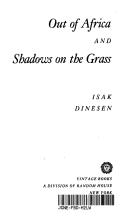
Talk to Out of Africa like its author wrote you back.
Get the ideas that fit your life — not generic summaries.
- Chat with the book
- Audiobook-style main ideas
- Adapts to your life and goals
- Helps you take action
Out of Africa, in detail
Out of Africa is Isak Dinesen's memoir of the seventeen years she spent running a coffee farm at the foot of the Ngong Hills outside Nairobi, from 1914 to 1931. It is not a linear narrative. There is no conventional plot. Instead, Dinesen assembles a series of portraits — of her Kikuyu workers, of Somali household staff, of the Masai neighbors she admired with something close to reverence, of the farm itself, which she loved with an intensity the book never quite explains but never needs to.
The voice is unlike almost anything else in memoir. Dinesen writes in English — her second language — with a cadence that is formal, slightly archaic, and strangely musical. She does not sentimentalize Africa, but she does idealize certain aspects of it: the landscape, the wild animals, the pride of the people she worked alongside. Her portrayals of African characters are sometimes paternalistic in ways that discomfort modern readers, and the book is worth reading with those limits in mind rather than past them.
What gives the memoir its lasting power is the quality of attention Dinesen brings to the visible world. The descriptions of the Ngong Hills at dawn, of a lion hunt on foot, of the Kikuyu elder Kinanjui dying with ceremonial dignity — these passages stay with the reader long after the narrative details blur. The underlying subject is not Africa so much as the grief of losing something you love, a grief Dinesen is too composed to announce directly but which accumulates through every page.
The book ends with the loss of the farm and Dinesen's return to Denmark. The final pages, in which she describes watching Denys Finch Hatton's plane disappear and then arranging his burial near the Ngong Hills, are among the most quietly devastating in twentieth-century prose. It is a book about belonging to a place that never fully belonged to her, and about the particular sorrow of knowing it.
The big ideas
- 1.
Dinesen's Africa is not an objective portrait but a personal one — a record of what the landscape and its people meant to a specific European woman at a specific historical moment.
- 2.
The memoir is organized around impressions and characters rather than chronology, which gives it an unusual texture closer to essays than conventional memoir.
- 3.
Her relationship with pilot Denys Finch Hatton is central to the book's emotional weight, though Dinesen describes it with characteristic restraint.
