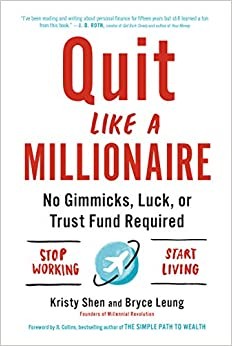
Talk to Quit Like a Millionaire like its author wrote you back.
Get the ideas that fit your life — not generic summaries.
- Chat with the book
- Audiobook-style main ideas
- Adapts to your life and goals
- Helps you take action
Quit Like a Millionaire, in detail
Quit Like a Millionaire is Kristy Shen and Bryce Leung's account of how they retired in their early thirties with a million-dollar portfolio assembled on middle-class incomes — and the mathematical framework that let them do it. Shen grew up in rural China during a period of genuine poverty, and the book opens there, using that contrast to argue that most North Americans dramatically overestimate how much they need to feel secure and underestimate how much they are spending without noticing.
The core of the book is the FIRE (Financial Independence, Retire Early) math. Shen explains the 4% safe withdrawal rule, the sequence-of-returns risk problem, and how to construct an investment portfolio with index funds and bonds that can sustain withdrawals indefinitely. She is more mathematically precise than most FIRE writing, walking through actual spreadsheets and showing why the number that matters isn't how much you earn but your savings rate. A household saving 50% of income can reach financial independence in roughly 16 years regardless of income level.
Shen also addresses the question most FIRE books dodge: what about healthcare, market downturns, and the unexpected costs of a 40- or 50-year retirement? Her answer is the Cash Cushion and Yield Shield strategy — holding a few years of living expenses in cash and building a portfolio that generates income slightly above your spending needs, so you avoid selling equities during crashes. The book is more defensive and risk-aware than the usual "quit your job and never look back" framing.
The writing mixes memoir with spreadsheet logic in a way that either clicks for you or feels choppy. Readers who haven't thought seriously about FIRE will find the math accessible and genuinely motivating. Those already deep in the community may find some sections basic. The book's real value is showing that early retirement is not reserved for people who earn enormous salaries — it is primarily a function of how much you spend.
The big ideas
- 1.
Financial independence is achieved through savings rate, not income. A household saving 50% reaches FI in roughly 16 years regardless of salary level.
- 2.
The 4% rule: if your portfolio is at least 25 times your annual spending, withdrawing 4% per year historically sustains a portfolio indefinitely.
- 3.
Sequence-of-returns risk — retiring just before a market crash — is the biggest threat to an early retiree. The Cash Cushion strategy reduces forced selling during downturns.
