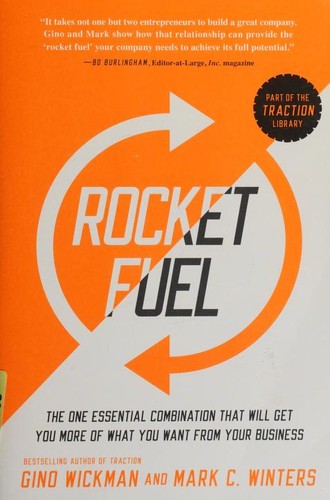
Talk to Rocket Fuel: The One Essential Combination That Will Get You More of What You Want from Your Business like its author wrote you back.
Get the ideas that fit your life — not generic summaries.
- Chat with the book
- Audiobook-style main ideas
- Adapts to your life and goals
- Helps you take action
Rocket Fuel: The One Essential Combination That Will Get You More of What You Want from Your Business, in detail
Rocket Fuel extends the EOS (Entrepreneurial Operating System) framework that Gino Wickman introduced in Traction by focusing on a specific organizational dynamic: the relationship between a Visionary and an Integrator. Wickman and Winters argue that most entrepreneurial companies struggle not because they lack vision or ideas, but because they lack someone to translate vision into operational reality. The Visionary-Integrator combination is, in their framing, the "one essential combination" that separates companies that scale from those that plateau or collapse under their own complexity.
The Visionary is the founder-type who generates ideas, sees around corners, builds relationships, and maintains culture and energy. They are typically poor at managing people, finishing projects, or maintaining consistent processes. The Integrator is the counterpart who executes: holding the leadership team accountable, managing the day-to-day, translating the Visionary's ideas into plans, and being the person the team comes to when things go wrong. Without an Integrator, the Visionary's strengths become liabilities — too many ideas, constant pivots, and an organization that never quite executes on its potential. Without a Visionary, the Integrator has no compelling direction to execute against.
The book is structured partly as a guide and partly as a story following two fictional characters through the process of finding, hiring, and working with an Integrator. The storytelling makes the dynamics vivid: the friction when a Visionary micromanages (because they don't trust the Integrator), the tension when an Integrator shuts down ideas too quickly (because they haven't fully understood the Visionary's logic), and the breakthroughs that happen when the relationship is working well. Wickman and Winters include diagnostic tools for identifying whether you are a Visionary or an Integrator, and for assessing whether a current or potential partner fits the complementary role.
The book's limitations are mainly those of the genre: it is evangelical about a single framework, and the case studies are all success stories. Not every company needs a dedicated Integrator role at the leadership level, and the Visionary-Integrator framing can obscure other organizational models that work well. But for founders who feel trapped between their own ambitions and their organization's inability to execute, Rocket Fuel offers a specific diagnosis and a concrete path forward.
The big ideas
- 1.
Most entrepreneurial companies fail to scale not because of bad vision but because they lack someone to execute that vision consistently. The Integrator role fills this gap.
- 2.
Visionaries and Integrators have fundamentally different strengths. Visionaries see possibilities; Integrators make things happen. Neither functions well without the other in a scaling company.
- 3.
The Visionary-Integrator relationship requires unusual levels of trust and explicit communication about accountability. When it breaks down, it usually breaks down over one person undermining the other's authority.
