Talk to Shape Up like its author wrote you back.
Get the ideas that fit your life — not generic summaries.
- Chat with the book
- Audiobook-style main ideas
- Adapts to your life and goals
- Helps you take action
Shape Up, in detail
Shape Up is Ryan Singer's account of how Basecamp builds software — a methodology developed over fifteen years and refined through hundreds of product cycles. The book is free online, which reflects Basecamp's general approach to sharing knowledge, and it has generated unusual interest for a product management text because it directly contradicts several widely held assumptions about how software development should work.
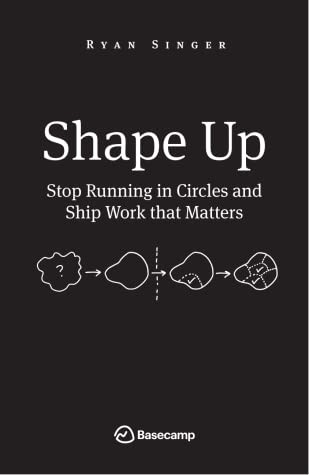
The process has three phases. Shaping is done by senior people before a project is put in front of a development team. A shaper takes a raw idea and works it into a "pitch" — a specific problem, a rough solution, and explicit boundaries on what the solution will and will not include. The shaping work happens offline, away from the development team, and its output is not a specification but a set of constraints and a direction. Betting is the process by which shaped work gets scheduled. Basecamp uses six-week cycles with no sprints, no backlog, and no rollover: each cycle starts with a clean slate, and the work that gets bet on gets a full six weeks without interruption. Building is done by small teams of one or two designers and one or two programmers who have full autonomy within the shaped boundaries. They are responsible for their own task management, their own scope decisions, and their own discoveries.
Singer's key concept is the "appetite" — the maximum time and energy Basecamp is willing to invest in a given solution — as the primary input to shaping, replacing the requirement that a solution be defined before a budget is set. If a problem isn't worth six weeks, it's a small project or not worth doing. The book also introduces "hill charts" as a way of communicating project progress without requiring detailed task tracking — a visual metaphor for whether work is still in problem-solving mode (uphill) or execution mode (downhill).
Shape Up is best read critically. The methodology was developed for a small, profitable, bootstrapped company with an unusual management philosophy and no external growth pressures. How much of it transfers to other organizational contexts is genuinely contested. The shaping concept and the six-week cycle are the parts most teams find directly applicable; the betting table process and the no-backlog philosophy require cultural conditions that many organizations cannot easily replicate. But the diagnosis of what goes wrong in software development — unclear ownership, feature creep, time estimates divorced from trade-off thinking — is accurate and valuable independent of whether the solutions apply.
The big ideas
- 1.
Shaping separates the fuzzy problem-definition work from execution. Shaped work arrives at the development team with clear boundaries and a defined appetite, not an open-ended specification.
- 2.
Appetite replaces estimate: instead of asking how long something will take, Basecamp asks how much time they are willing to spend on it. That shift forces honest prioritization.
- 3.
Six-week cycles without sprints, no backlog, and no rollover create meaningful boundaries. When a cycle ends, teams reassess from scratch rather than inherit unfinished work.
