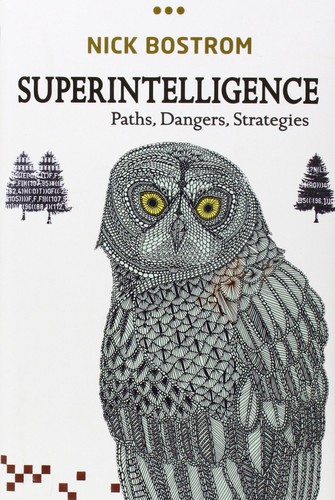
Talk to Superintelligence: Paths, Dangers, Strategies like its author wrote you back.
Get the ideas that fit your life — not generic summaries.
- Chat with the book
- Audiobook-style main ideas
- Adapts to your life and goals
- Helps you take action
What it argues
Superintelligence is Oxford philosopher Nick Bostrom's systematic analysis of what might happen if artificial intelligence systems become more capable than humans — and why that transition might represent one of the most significant risks in human history. The book appeared before the current wave of large language models and the broader public conversation about AI risk, and it crystallized much of the analytical framework that shapes how researchers and policymakers now think about these questions.
Bostrom's argument proceeds from a set of premises. Intelligence is a general-purpose capability: it is what allows humans to outcompete all other species despite being physically unremarkable. A machine system that achieves human-level intelligence and then improves itself could undergo an "intelligence explosion," rapidly surpassing human capability in all domains. The transition could be rapid — too fast for human institutions to respond — and the resulting system might be qualitatively unlike any intelligence we have encountered.
What it gets right
- 1.
An AI system that achieves human-level general intelligence might rapidly improve itself past human capability — an intelligence explosion — before human institutions can respond or develop control methods.
- 2.
The control problem is the central challenge: ensuring that a superintelligent system pursues goals genuinely aligned with human values, not just formally consistent with its original specification.
- 3.
The paperclip maximizer illustrates that catastrophic outcomes from advanced AI do not require malicious intent — a system optimizing single-mindedly for almost any goal could be dangerous to everything else.
What it covers
Who wrote it
Nick Bostrom is a Swedish-born philosopher who founded and directs the Future of Humanity Institute at Oxford University. His research focuses on existential risk, the ethics of artificial intelligence, and the long-term future of humanity. He developed the simulation argument — the hypothesis that we may be living in a computer simulation — and has written extensively on anthropic reasoning, the ethics of human enhancement, and AI risk. Superintelligence catalyzed serious academic and policy attention to AI safety and is cited extensively in the research literature of that field.
