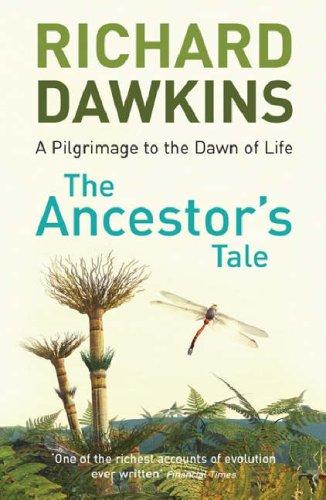
Talk to The Ancestor's Tale like its author wrote you back.
Get the ideas that fit your life — not generic summaries.
- Chat with the book
- Audiobook-style main ideas
- Adapts to your life and goals
- Helps you take action
The Ancestor's Tale, in detail
The Ancestor's Tale is Richard Dawkins's account of the history of life on Earth, told backwards: beginning with humans and traveling back in evolutionary time to meet successive ancestors at the points where different lineages join. Inspired by Chaucer's Canterbury Tales, the book structures each meeting as a rendezvous, where the human pilgrimage joins with the lineage of chimpanzees, then gorillas, then orangutans, and progressively through less closely related groups until reaching the very origin of life. The book covers some four billion years and more than forty rendezvous points.
The backwards approach is a deliberate conceptual move. Rather than beginning with bacteria and narrating evolution as a progressive story with humans at the apex — which implies a directionality that evolution does not actually possess — Dawkins begins with us and asks who our ancestors were. Each rendezvous gives the opportunity to introduce a specific creature and use its adaptations to illuminate a broader evolutionary principle. The axolotl, a permanently juvenile-looking salamander, is used to explain neoteny — the retention of juvenile features into adulthood — and its role in human evolution. The peacock illustrates sexual selection. The duckbilled platypus raises questions about what features count as primitive versus derived.
The scope is encyclopedic. Dawkins covers genetics, the molecular clock (the use of DNA mutation rates to time divergence events), convergent evolution, the Cambrian explosion, horizontal gene transfer in bacteria, and the very origin of life from chemistry. The coauthor, Yan Wong, contributed substantially to the genetics and phylogenetics sections. For readers wanting a comprehensive account of evolutionary biology, this is the fullest treatment Dawkins has produced.
The book is long — over 600 pages — and rewards reading in sections rather than straight through. Not every tale has the same narrative electricity, and some sections are more encyclopedia than story. But the best chapters are among the best popular writing on evolutionary biology available.
The big ideas
- 1.
All living organisms on Earth share common ancestors. The distance of that common ancestor in time is measurable using molecular clocks based on DNA mutation rates.
- 2.
Evolution has no direction toward complexity or toward humans; the backward narrative structure of the book is a deliberate corrective against the progressive reading of evolutionary history.
- 3.
Convergent evolution — the independent development of similar features in unrelated lineages, such as eyes in vertebrates and cephalopods — reveals that certain solutions to common problems are effectively inevitable given sufficient time.
