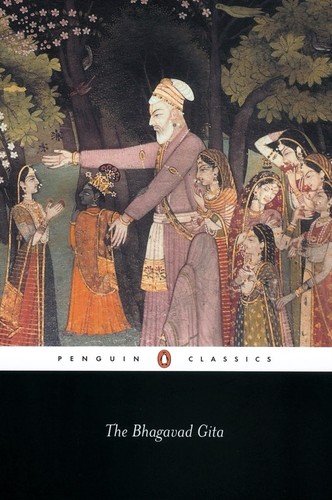
Talk to The Bhagavad Gita like its author wrote you back.
Get the ideas that fit your life — not generic summaries.
- Chat with the book
- Audiobook-style main ideas
- Adapts to your life and goals
- Helps you take action
What it argues
The Bhagavad Gita — the Song of the Lord — is an episode embedded in the Sanskrit epic Mahabharata, composed between the 5th and 2nd centuries BCE. It takes the form of a dialogue between the warrior prince Arjuna and his charioteer Krishna, revealed at the start to be an avatar of the god Vishnu, on the eve of a catastrophic battle between two branches of the same royal family. Arjuna's moral crisis — how can he fight and kill his own teachers, cousins, and kinsmen? — becomes the occasion for one of the most comprehensive philosophical and theological texts in world literature.
Krishna's first response is ontological: the Self (Atman) is eternal and cannot be killed. What Arjuna fears destroying — these beloved people — are temporary forms. The deathless Self that inhabits each body was never born and will never die. Grief for the bodies of the slain is a failure to understand what a person actually is. This metaphysical claim grounds the entire subsequent argument: if the Self is eternal, then clinging to outcomes and fearing death are forms of ignorance about one's own nature.
What it gets right
- 1.
The eternal Self (Atman) was never born and will never die; what we call death is the shedding of a temporary form, not the destruction of the true self.
- 2.
Nishkama karma — action without attachment to results — is the central practical teaching: do your duty fully and release the outcome.
- 3.
Dharma (duty, right conduct) is specific to one's nature and station; performing your own duty imperfectly is better than performing another's duty well.
What it covers
Who wrote it
The Bhagavad Gita is part of the Mahabharata, the Sanskrit epic composed over several centuries beginning around 400 BCE. Its authorship is traditionally attributed to the sage Vyasa, who is himself a character in the Mahabharata. The text synthesizes several strands of Hindu philosophy — Samkhya metaphysics, Upanishadic teachings on Atman and Brahman, and devotional bhakti — into a single teaching. It has inspired an enormous body of commentary from Adi Shankaracharya to Ramanuja to modern interpreters including Swami Vivekananda, Sri Aurobindo, and Mahatma Gandhi.
