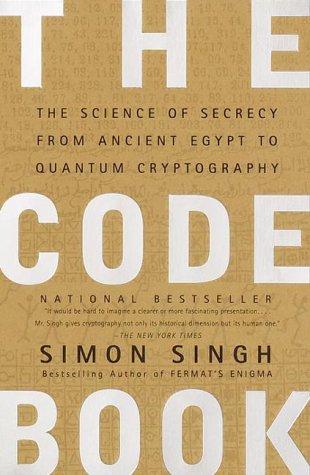
Talk to The Code Book: The Science of Secrecy from Ancient Egypt to Quantum Cryptography like its author wrote you back.
Get the ideas that fit your life — not generic summaries.
- Chat with the book
- Audiobook-style main ideas
- Adapts to your life and goals
- Helps you take action
What it argues
Simon Singh's The Code Book traces the history of cryptography from Caesar's cipher through the breaking of Enigma to the mathematics of public-key encryption and the looming possibility of quantum cryptography. Singh is one of the best science writers working, and this is probably his strongest book — the historical narrative gives the mathematics context and stakes, and the mathematics makes the history more than just a parade of dramatic stories.
The book's structure is roughly chronological but organized around key technical breakthroughs. Early chapters cover monoalphabetic and polyalphabetic substitution ciphers, the Arab polymaths who invented frequency analysis to break them, and the centuries-long cat-and-mouse game between encryption and cryptanalysis. The Vigenère cipher was considered unbreakable for three hundred years before Charles Babbage and Friedrich Kasiski independently found its weakness in the nineteenth century. Singh explains both the cipher and its breaking clearly, and the chapter works as a standalone lesson in analytical thinking.
What it gets right
- 1.
Every encryption method has been broken eventually. The history of cryptography is a continuous arms race between encryption and cryptanalysis, not a story of permanent solutions.
- 2.
Frequency analysis — counting how often each letter appears in ciphertext — defeated monoalphabetic substitution ciphers and was developed by Arab scholars in the ninth century, centuries before European cryptography.
- 3.
The Vigenère cipher resisted cryptanalysis for 300 years before Babbage and Kasiski independently identified its vulnerability: repeated key patterns produce statistical regularities detectable by frequency analysis.
What it covers
Who wrote it
Simon Singh is a British science writer with a PhD in particle physics from Cambridge. His other books include Fermat's Last Theorem, which traces the 350-year proof of the problem and became a bestseller, and The Big Bang, a history of cosmological science. Singh writes with the conviction that non-specialists can understand difficult mathematics if it is explained with sufficient care and context. He has also written for The Sunday Times and produced documentary films for the BBC. The Code Book, published in 1999, has sold over a million copies and is considered one of the best popular treatments of cryptography.
