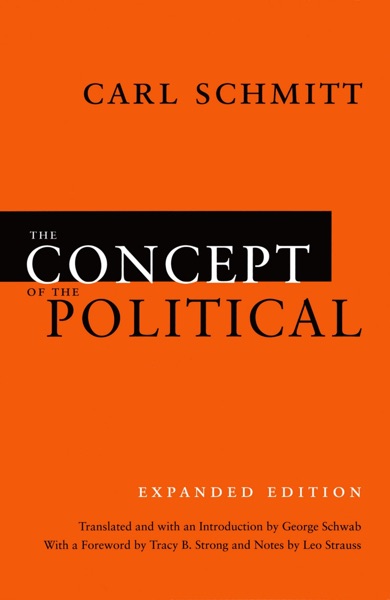
Talk to The Concept of the Political like its author wrote you back.
Get the ideas that fit your life — not generic summaries.
- Chat with the book
- Audiobook-style main ideas
- Adapts to your life and goals
- Helps you take action
The Concept of the Political, in detail
Carl Schmitt's central move in The Concept of the Political is definitional: he argues that the specifically political distinction is the distinction between friend and enemy. Not love and hate, not good and evil, not profit and loss — the political realm is constituted by the intensity of association and dissociation that produces a group's sense of itself in opposition to something external that threatens it. Politics isn't about managing competing interests within an agreed framework; it's about the possibility that the conflict can become existential, and that this possibility is what makes the political irreducibly different from economics, morality, or aesthetics.
Schmitt's argument is a sustained critique of liberal political theory. Liberalism, in his account, tries to dissolve the political by converting every conflict into either an economic negotiation or a moral debate. Trade will make wars unnecessary; reasonable discussion will resolve disagreements. Schmitt's objection is that this denies the reality of the friend-enemy distinction without eliminating it. Real political conflicts don't become negotiations just because we'd prefer them to. Trying to treat them as if they do is not pacification — it is evasion that leaves the state unable to act at the moment when acting is most necessary.
The book's most controversial implication is the concept of sovereignty: the sovereign is the one who decides the exception. In normal times, legal rules govern everything. But in a genuine emergency — Schmitt's "state of exception" — the normal legal order is suspended by whoever has the power to suspend it, and that person or body is the real sovereign regardless of what the constitutional documents say. This argument was developed most fully in Schmitt's earlier Politische Theologie, but it underlies The Concept of the Political as well.
Reading Schmitt requires confronting his biography. He joined the Nazi Party in 1933 and provided intellectual justification for the regime's actions until he was edged out by SS rivals in 1936. This history is inseparable from his work: his critique of liberal parliamentarism and his theory of sovereignty were tools that could be — and were — used to justify authoritarian power. The arguments themselves are analytically sharp and widely influential. Walter Benjamin, Hannah Arendt, Jacques Derrida, Giorgio Agamben, and Chantal Mouffe have all engaged seriously with them. Reading Schmitt without engaging his politics is naive; dismissing him because of his politics means missing arguments that have had, and continue to have, enormous influence on how political situations are analyzed and acted on.
The big ideas
- 1.
The political is defined by the friend-enemy distinction. Political conflicts are those intense enough that the parties see each other as existential threats, not mere competitors.
- 2.
Schmitt's critique of liberalism is that it tries to convert political conflicts into economic or moral disputes, denying their specifically political character rather than managing it.
- 3.
The sovereign is whoever decides the exception — whoever has the actual power to suspend the normal legal order when they determine an emergency requires it.
