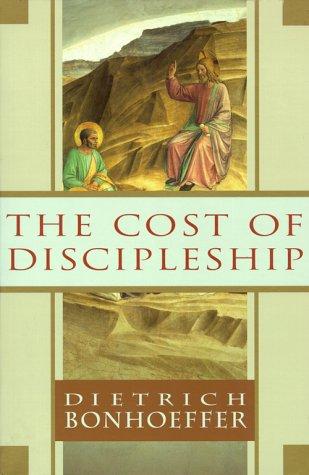
Talk to The Cost of Discipleship like its author wrote you back.
Get the ideas that fit your life — not generic summaries.
- Chat with the book
- Audiobook-style main ideas
- Adapts to your life and goals
- Helps you take action
What it argues
The Cost of Discipleship was published in Germany in 1937, four years after Hitler came to power and two years after Bonhoeffer had taken over the underground seminary at Finkenwalde. The book opens with one of the most memorable phrases in twentieth-century Christian writing: the distinction between cheap grace and costly grace. Cheap grace is forgiveness without repentance, doctrine without obedience, sacraments without commitment — the church granting absolution wholesale without requiring anything in return. Costly grace is the call to follow Jesus, which means the cross. Bonhoeffer was writing against a German Protestant church he believed had sold its soul to accommodate the Nazi state, and his readers knew it.
The first part of the book is theological and polemical. Bonhoeffer argues that the Reformation's doctrine of grace by faith alone has been distorted into a license for moral passivity. Luther understood that faith and obedience were inseparable; his heirs had used his language to separate them. The corrective Bonhoeffer offers is not a return to works-righteousness but a recovery of the simplicity of the call: when Jesus says "follow me," the only response is to follow, not to deliberate.
What it gets right
- 1.
Cheap grace is grace without discipleship, forgiveness without repentance, the sacraments administered without requiring change. Costly grace is the gospel that confronts the whole person and calls them to follow.
- 2.
Bonhoeffer argues that Luther's doctrine of grace by faith was never meant to separate faith from obedience. The Reformation's heirs had used its language to license moral passivity.
- 3.
The call to discipleship is simple and direct: when Jesus says 'Follow me,' the response is either obedience or refusal. Deliberation is itself a form of refusal.
What it covers
Who wrote it
Dietrich Bonhoeffer (1906–1945) was a German Lutheran pastor and theologian who became one of the most prominent Christian resisters to the Nazi regime. He studied at Tübingen and Berlin and completed a second doctorate at Union Theological Seminary in New York. In 1933 he began publicly opposing Hitler. He ran the Confessing Church's underground seminary at Finkenwalde until it was closed by the Gestapo in 1937. He was arrested in 1943, held in Tegel Prison, and transferred to Flossenbürg concentration camp, where he was executed on April 9, 1945. His other major works include Ethics and Letters and Papers from Prison.
