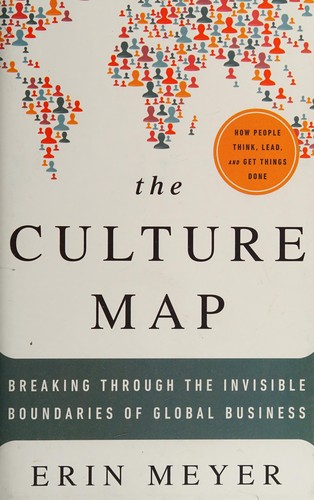
Talk to The Culture Map like its author wrote you back.
Get the ideas that fit your life — not generic summaries.
- Chat with the book
- Audiobook-style main ideas
- Adapts to your life and goals
- Helps you take action
The Culture Map, in detail
The Culture Map is Erin Meyer's framework for understanding the eight dimensions along which national cultures differ most consequentially for business leadership. Meyer is a professor at INSEAD who has spent her career studying how cultural differences create systematic misunderstandings between people who believe they're communicating clearly — and how to navigate those differences without flattening them.
The eight scales are: Communicating (low-context versus high-context), Evaluating (direct versus indirect negative feedback), Persuading (principle-first versus application-first), Leading (egalitarian versus hierarchical), Deciding (consensual versus top-down), Trusting (task-based versus relationship-based), Disagreeing (confrontational versus avoidance-oriented), and Scheduling (linear time versus flexible time). Meyer plots countries on each scale, creating a visual map of how any two cultures relate to each other on each dimension.
The most important insight is that the scales don't always align predictably. A culture that is low-context (direct explicit communication) may also be indirect in delivering negative feedback. The US is famously explicit in communication but notably indirect in giving criticism. The Netherlands is direct in both. Japan is high-context in communication and extremely indirect in feedback. Understanding the specific profile of each dimension — rather than collapsing cultures into "direct" or "indirect" overall — is what makes the framework useful.
Meyer draws heavily on her own experience and that of executives she has coached, producing a book that is concrete rather than academic despite being well-grounded in cross-cultural research. The limitations are real — national culture profiles are averages that obscure enormous individual variation, and the framework risks reinforcing stereotypes if applied mechanically. Meyer acknowledges this throughout, and the book is most useful as a lens for noticing patterns that might otherwise go unexamined.
The big ideas
- 1.
Eight dimensions determine the most consequential cultural differences for leadership: communicating, evaluating, persuading, leading, deciding, trusting, disagreeing, and scheduling.
- 2.
Cultural profiles on each dimension are independent — a culture can be low-context in communication while being highly indirect in delivering negative feedback. Collapsing all dimensions into a single axis misleads.
- 3.
Low-context cultures (US, Germany, Australia) assume communication should be explicit. High-context cultures (Japan, China, Korea) assume much is understood without being stated. Neither is superior; both create systematic misunderstanding when mixed.
