Talk to The Daily Stoic like its author wrote you back.
Get the ideas that fit your life — not generic summaries.
- Chat with the book
- Audiobook-style main ideas
- Adapts to your life and goals
- Helps you take action
The Daily Stoic, in detail
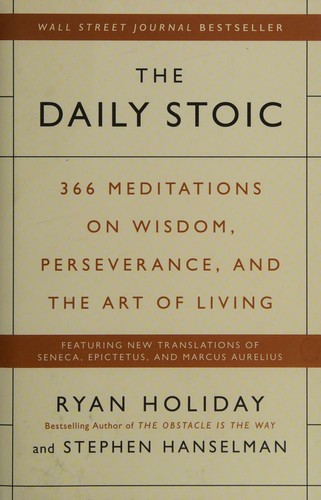
The Daily Stoic is a 366-entry collection of meditations drawn from the Stoic philosophers — Marcus Aurelius, Epictetus, Seneca, and lesser-known figures like Cato and Zeno. Holiday and Hanselman organize the entries by theme across three broad sections: perception, action, and will. Each day offers a translated passage (many freshly rendered from Greek and Latin), a paragraph of commentary, and a brief prompt. The intent is practice, not scholarship.
The book's underlying argument is that Stoicism is not pessimism or emotional suppression, but a set of mental disciplines for living well under conditions you don't fully control. The Stoics believed that the quality of your life depends almost entirely on how you interpret events, not on the events themselves. This is the dichotomy of control: some things are up to you, and many things are not. The daily practice is learning to respond to both categories with clarity rather than anxiety or ego.
Several ideas appear repeatedly through the year. The concept of memento mori — remembering that you will die — is not meant to be morbid. It's meant to strip away trivialities and force honest questions about how time is spent. The Stoic idea of the "obstacle as the way" holds that adversity contains an opportunity if you look at it correctly: the thing blocking your path becomes the path. And the practice of negative visualization — imagining loss before it happens — is described as a tool for gratitude, not dread.
The format is both the book's strength and its limitation. Reading one entry a day for a year produces a slow, cumulative familiarity with Stoic ideas that no single reading of Marcus Aurelius' Meditations achieves on its own. Holiday's commentary is accessible without being dumbed down, and the original passages retain enough strangeness to resist becoming clichés. The limitation is that the book rewards dipping over cover-to-cover reading, and some entries feel thin when read in sequence. As an introduction to Stoic philosophy it works well; as a standalone philosophical treatment it necessarily stays shallow. Those who want the original sources should read the Meditations or Seneca's letters after this.
The big ideas
- 1.
The dichotomy of control is the foundation of Stoic practice: some things are up to you, some are not. Clarity about which is which eliminates most unnecessary suffering.
- 2.
Memento mori — the practice of remembering your mortality — is not morbid. It's a tool for prioritization, stripping away what doesn't matter so you can focus on what does.
- 3.
The obstacle is the way. Adversity isn't a detour from your path; the Stoics argued it contains the path. Resistance becomes the work.
