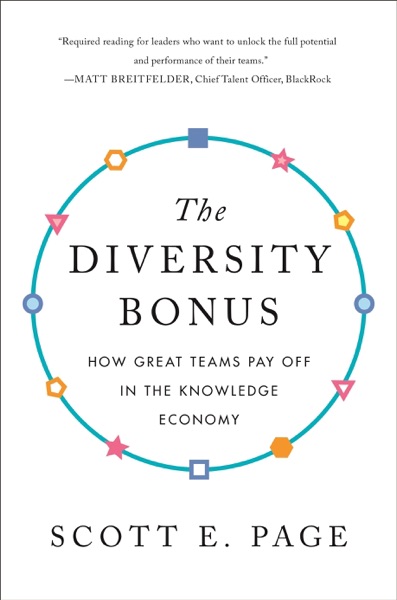
Talk to The Diversity Bonus like its author wrote you back.
Get the ideas that fit your life — not generic summaries.
- Chat with the book
- Audiobook-style main ideas
- Adapts to your life and goals
- Helps you take action
What it argues
The Diversity Bonus is Scott Page's empirical argument that diverse teams — diverse in perspective, training, experience, and identity — systematically outperform homogeneous ones on complex cognitive tasks. Page, a political scientist and complex systems researcher at the University of Michigan, grounds the argument not in fairness or ethics but in logic and evidence. The book's central claim is that diversity is not a cost businesses pay to be good citizens; it is a performance asset when the task is sufficiently complex.
The key distinction Page draws is between talent and diversity. For simple, measurable tasks, talent dominates. If you need someone to lift the most weight or solve a routine equation, you want the most talented individual. But for complex, nonlinear problems — designing a product, predicting a market, diagnosing an illness, building software — diversity of approach, model, and heuristic outperforms any collection of people with the same tools. This is what Page calls the "diversity bonus": the additional problem-solving capability that comes from having people who literally think differently.
What it gets right
- 1.
For complex problems, diverse teams consistently outperform homogeneous teams — including homogeneous teams of individually high-performing people.
- 2.
The diversity bonus depends on task complexity. For simple, well-defined problems, talent matters more than diversity. For complex problems, cognitive diversity dominates.
- 3.
Cognitive diversity — different mental models, heuristics, and problem representations — is the proximate cause of the diversity bonus. Identity diversity tends to generate cognitive diversity because life experience shapes thought.
What it covers
Who wrote it
Scott E. Page is the Leonid Hurwicz Collegiate Professor of Complex Systems, Political Science, and Economics at the University of Michigan. He is a pioneer in the study of complex adaptive systems and has written widely on diversity, collective intelligence, and social science modeling. His earlier book The Difference laid the mathematical foundations for the diversity-as-performance argument. He is also a Santa Fe Institute external faculty member and lectures extensively on complexity in organizational contexts.
