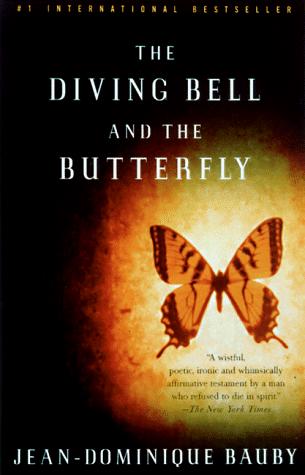
Talk to The Diving Bell and the Butterfly like its author wrote you back.
Get the ideas that fit your life — not generic summaries.
- Chat with the book
- Audiobook-style main ideas
- Adapts to your life and goals
- Helps you take action
The Diving Bell and the Butterfly, in detail
Jean-Dominique Bauby was the editor-in-chief of French Elle when he suffered a massive stroke in December 1995 that left him with complete paralysis of his body except for his left eyelid. The condition is called locked-in syndrome. He could see, hear, think, feel, and remember everything. He could move nothing. This book, dictated by blinking as an assistant read the alphabet and paused when he reached the right letter, was composed over ten months and published two days before Bauby died in 1997.
The miracle of the book is not that it was written under those conditions — though that is remarkable — but that it doesn't dwell on the conditions. Bauby uses his paralyzed body as a diving bell, sinking beneath the surface of ordinary life, and his imagination as the butterfly that can still move. He travels in memory to restaurant meals, to road trips with his father, to fantasies of escape. He describes the hospital world around him — his therapists, his visitors, the view of the sea from his window — with precision and occasional dark humor.
The prose is dense with sensation in a way that reads like deliberate compensation. A man who can no longer eat describes elaborate meals. A man who can no longer move describes the physical pleasure of travel with longing that is neither sentimental nor self-pitying. Bauby is not performing courage; he seems genuinely more interested in the life of the mind than in mourning the life of the body.
The book is very short — under a hundred pages — but it is not slight. It asks, indirectly, what constitutes a self when the body is removed from the equation, and what remains of a life when almost everything is taken away. The answer Bauby offers is not consoling in any conventional sense. What remains is the capacity for attention, and his is, even at the end, formidable.
The big ideas
- 1.
Bauby composed the entire book by blinking his left eye as an assistant read an alphabet ordered by frequency — each letter took multiple rounds, each page took hours.
- 2.
Locked-in syndrome leaves the mind fully intact while the body is almost completely paralyzed — a condition that forces a radical redefinition of what it means to be present.
- 3.
Memory and imagination function as escape: Bauby travels to places, people, and meals he can no longer access physically but can reconstruct in elaborate detail.
