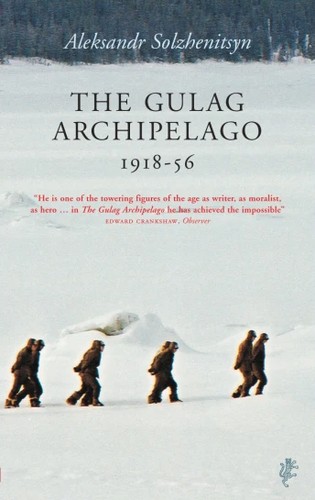
Talk to The Gulag Archipelago like its author wrote you back.
Get the ideas that fit your life — not generic summaries.
- Chat with the book
- Audiobook-style main ideas
- Adapts to your life and goals
- Helps you take action
What it argues
The Gulag Archipelago is Aleksandr Solzhenitsyn's monumental account of the Soviet forced-labor camp system. Written in secret between 1958 and 1968 and smuggled to the West, the book draws on Solzhenitsyn's own eleven years in the camps along with testimonies from more than two hundred former prisoners. It is not a single narrative but a vast, sprawling investigation — part history, part memoir, part moral indictment — that traces the system from its origins under Lenin through its full expansion under Stalin.
The book's central argument is that the Gulag was not an aberration or a Stalinist distortion of socialist ideals. Solzhenitsyn traces the system's ideological roots to Marxist-Leninist doctrine itself: the willingness to sacrifice individual human beings to an abstract historical project. He documents arrest procedures, interrogation methods, transport in frozen cattle cars, camp hierarchies, the economics of slave labor, and the daily calculus of survival. The scale is almost incomprehensible — tens of millions of arrests, millions of deaths — but Solzhenitsyn insists on individual stories, names, faces.
What it gets right
- 1.
The Gulag was not a Stalinist aberration but an expression of Leninist ideology — the systematic subordination of individuals to a claimed historical necessity.
- 2.
The arrest and interrogation system was designed not to find guilty parties but to produce confessions, feeding a bureaucratic machine that required constant human fuel.
- 3.
Survival in the camps depended on luck, physical constitution, willingness to compromise, and access to camp hierarchies — not on innocence or guilt.
What it covers
Who wrote it
Aleksandr Solzhenitsyn (1918–2008) was a Russian novelist and historian who spent eight years in Soviet labor camps and was later exiled from the USSR in 1974. He was awarded the Nobel Prize in Literature in 1970. His novels One Day in the Life of Ivan Denisovich and Cancer Ward drew on his camp experience, but The Gulag Archipelago — published in the West starting in 1973 — was his most ambitious and politically explosive work. He returned to Russia in 1994 after the Soviet collapse and continued writing until his death.
