Talk to The Happiness Hypothesis like its author wrote you back.
Get the ideas that fit your life — not generic summaries.
- Chat with the book
- Audiobook-style main ideas
- Adapts to your life and goals
- Helps you take action
What it argues
Jonathan Haidt is a social psychologist at NYU who spent the early part of his career studying morality and happiness, and this book — published in 2006, before his work on political psychology brought him wider attention — synthesizes ancient philosophical wisdom with modern psychological research. The organizing premise is that great thinkers in multiple traditions converged on certain insights about the good life, and that modern psychology is in a position to evaluate whether those insights were correct.
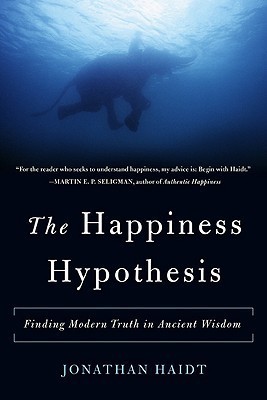
The book's central metaphor is the rider and the elephant. The rational conscious mind is the rider; the vast, automatic, emotional, and intuitive system is the elephant. The elephant is stronger and faster, and the rider can guide it but cannot override it by force. This precedes and parallels Kahneman's System 1/System 2 framework, though Haidt uses it for a different purpose — to explain why insight alone rarely changes behavior, and why working with the elephant's tendencies rather than against them is the effective strategy.
What it gets right
- 1.
The rider and elephant metaphor: the rational mind cannot control the emotional mind by force. Working with the emotional system — through environment design, habit, and practice — is more effective than commanding it.
- 2.
The hedonic treadmill means lottery winners and paraplegics return to approximately their prior level of life satisfaction within a year of their event. External circumstances matter less than we expect for lasting happiness.
- 3.
The adaptation principle has a flip side: we adapt to positive events as well as negative ones, which is why acquiring things rarely delivers lasting satisfaction and why savoring and gratitude have real effects.
What it covers
Who wrote it
Jonathan Haidt is Thomas Cooley Professor of Ethical Leadership at New York University's Stern School of Business. He has written three books: The Happiness Hypothesis, The Righteous Mind, which examines the moral psychology of political disagreement, and The Coddling of the American Mind, co-authored with Greg Lukianoff. He is also co-founder of Heterodox Academy and has been a prominent voice in debates about free speech, social media, and adolescent mental health. His academic work focuses on moral emotions, moral foundations theory, and the psychology of meaning.
