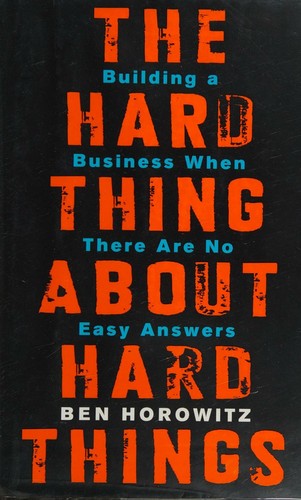
Talk to The Hard Thing About Hard Things like its author wrote you back.
Get the ideas that fit your life — not generic summaries.
- Chat with the book
- Audiobook-style main ideas
- Adapts to your life and goals
- Helps you take action
What it argues
The Hard Thing About Hard Things is Ben Horowitz's account of what it actually feels like to run a company through crisis. Horowitz co-founded and ran Loudcloud, which nearly went bankrupt before pivoting into Opsware and eventually selling to Hewlett-Packard for $1.6 billion. The book draws on that experience to make a single blunt argument: most business advice is written for when things are going reasonably well. It has almost nothing to say about what to do when nothing is going well and the stakes are real.
Horowitz structures the book around what he calls "the Struggle" — the period when the company feels like it's failing, when there is no good answer, and when the CEO must make consequential decisions under conditions of near-total uncertainty. He covers layoffs, executive firings, demotions, company-destroying competition, and the personal psychological toll of leadership. His advice is deliberately unsentimental: fire people who aren't doing their jobs, don't dilute your culture by tolerating behavior in executives that you wouldn't tolerate elsewhere, and don't let the company's pain become everyone else's problem. He also argues that most management frameworks assume a peacetime company, but a company fighting for survival needs a wartime CEO — someone willing to make unilateral, fast, even unpopular decisions to keep the company alive.
What it gets right
- 1.
Most business advice is written for companies that are functioning. The decisions that actually determine survival happen in "the Struggle," when nothing is working and there are no good options.
- 2.
Wartime and peacetime CEOs are different jobs. A peacetime CEO delegates, builds consensus, and protects culture. A wartime CEO breaks rules, moves fast, and prioritizes survival over harmony.
- 3.
Don't let problems that need solving fester because they are uncomfortable to address. Firing a poor-performing executive late costs far more than firing them early.
What it covers
Who wrote it
Ben Horowitz is a co-founder and general partner of Andreessen Horowitz, one of Silicon Valley's most prominent venture capital firms. Before investing, he co-founded Loudcloud, which became Opsware and was acquired by Hewlett-Packard in 2007 for $1.6 billion. He later wrote What You Do Is Who You Are, a follow-up focused on company culture. Horowitz is known for direct writing aimed at founders and operators, drawing on his own experience running a company through near-bankruptcy rather than on academic research or secondary observation.
