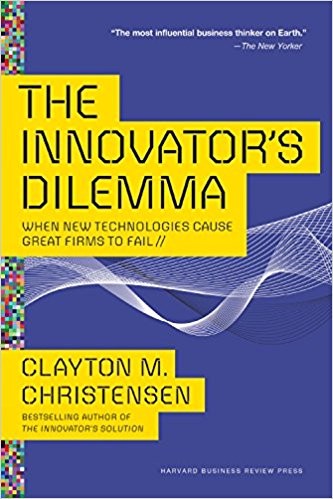
Talk to The Innovator's Dilemma like its author wrote you back.
Get the ideas that fit your life — not generic summaries.
- Chat with the book
- Audiobook-style main ideas
- Adapts to your life and goals
- Helps you take action
What it argues
Christensen's argument, published in 1997, is deceptively simple: the very practices that make companies excellent at serving their current customers — listening carefully, investing in proven technologies, targeting the most profitable segments — are precisely what causes them to miss disruptive innovations. He calls this the innovator's dilemma, and he builds the case through detailed examination of the disk drive industry, steel minimills, hydraulic excavators, and retail stores. In each case, the pattern repeats with uncomfortable regularity: the best-managed companies in an industry are systematically the most vulnerable to displacement by upstarts with inferior products and lower margins.
Disruption, in Christensen's framework, does not begin with a better product. It begins with a worse one — cheaper, simpler, and initially appealing only to customers the incumbents don't care about. The new technology underperforms on the metrics that matter to existing customers, so rational managers at established firms ignore it or explicitly decide not to pursue it. Then the technology improves. The disruptor moves upmarket. By the time the incumbent recognizes the threat, the competitor has an established cost structure, a loyal customer base, and a trajectory that the incumbent cannot easily match. IBM missed the minicomputer. DEC missed the personal computer. Sears missed Walmart. The steelmakers with integrated mills watched the minimills take low-margin rebar first, then structural steel, then eventually threaten sheet steel. At each stage, the integrated mill managers made individually rational decisions that collectively amounted to strategic failure.
What it gets right
- 1.
Successful companies fail not because of poor management but because of good management. Listening to current customers and optimizing for existing margins leads firms to miss the next wave.
- 2.
Disruptive innovations start out worse on every metric that established customers care about. They are cheaper, simpler, and aimed at non-consumers or the least demanding segment of the market.
- 3.
The disk drive industry illustrates the pattern most clearly: each generation of drive makers was upended by smaller, cheaper drives they had the technology to build but chose not to pursue.
What it covers
Who wrote it
Clayton M. Christensen was the Kim B. Clark Professor of Business Administration at Harvard Business School. He studied why successful companies fail to adapt to technological change and wrote nine books on innovation and management, including The Innovator's Solution, Competing Against Luck, and How Will You Measure Your Life? His work shaped how the technology industry talks about startups, incumbents, and market change. He received the McKinsey Award for the best Harvard Business Review article five times. Christensen died in January 2020.
