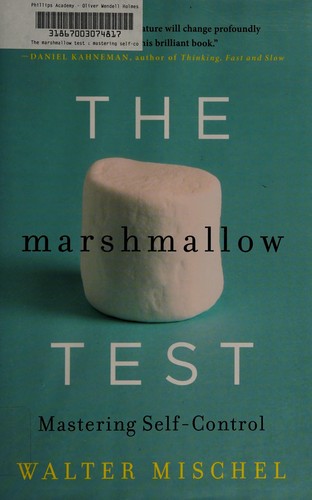
Talk to The Marshmallow Test: Mastering Self-Control like its author wrote you back.
Get the ideas that fit your life — not generic summaries.
- Chat with the book
- Audiobook-style main ideas
- Adapts to your life and goals
- Helps you take action
What it argues
Walter Mischel designed the marshmallow test at Stanford in the late 1960s: a child is left alone in a room with a marshmallow and told that if they can wait for the researcher to return without eating it, they'll get two. The experiment was playful by design, but the follow-up data turned it into one of psychology's most cited longitudinal studies. Children who waited longer had better outcomes decades later — higher SAT scores, lower rates of addiction, better stress management, more stable relationships. The book is Mischel's account of what he and his colleagues learned from fifty years of studying self-control.
The central finding is that self-control is not primarily about willpower in the sense of gritting your teeth and bearing discomfort. It's about cognitive strategies that change how you represent the temptation. Children who waited the longest didn't display the most stoic suffering — they transformed the situation mentally. They looked away from the marshmallow, sang songs, or pretended the marshmallow was a picture rather than food. Mischel's term is "cool vs. hot" processing: when the emotional, impulsive hot system dominates, self-control fails; when the cool, deliberate system can reframe the situation, it becomes manageable.
What it gets right
- 1.
Self-control is primarily about cognitive strategies that reframe temptation, not about willpower or stoic endurance of discomfort.
- 2.
The 'hot' system processes stimuli emotionally and impulsively; the 'cool' system processes deliberately and abstractly. Self-control means activating the cool system when the hot system fires.
- 3.
Children who waited longest in the marshmallow test didn't stare down the temptation — they distracted themselves, reframed the marshmallow mentally, or simply looked away.
What it covers
Who wrote it
Walter Mischel (1930–2018) was a professor of psychology at Columbia University and one of the most influential personality and social psychologists of the twentieth century. Born in Vienna, he emigrated to the United States and earned his doctorate at Ohio State University. He spent much of his career at Stanford, where he designed the marshmallow test, and later at Columbia. His research on self-control, personality consistency, and cognitive-behavioral strategies shaped contemporary clinical and developmental psychology.
