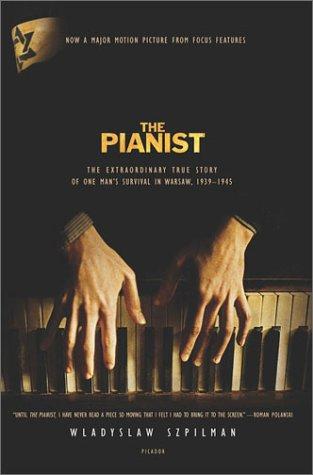
Talk to The Pianist: The Extraordinary True Story of One Man's Survival in Warsaw, 1939-45 like its author wrote you back.
Get the ideas that fit your life — not generic summaries.
- Chat with the book
- Audiobook-style main ideas
- Adapts to your life and goals
- Helps you take action
The Pianist: The Extraordinary True Story of One Man's Survival in Warsaw, 1939-45, in detail
The Pianist is Wladyslaw Szpilman's account of surviving the German occupation of Warsaw from 1939 to 1945. Szpilman was a celebrated Polish-Jewish pianist at Polish Radio when Germany invaded. Over the following years he watched his family deported to Treblinka, hid in increasingly desperate circumstances throughout the Warsaw Ghetto and later in the abandoned ruins of the city, and was finally sheltered by a German officer, Wilm Hosenfeld, who recognized him as a musician and kept him alive through the final months of the war. He emerged to find the city almost completely destroyed.
The book was first written in 1945 and then suppressed under Communist Poland for political reasons — it featured a sympathetic German as a central figure. It was finally published in full in 1998, a year before Szpilman's death, and brought to international attention after Roman Polanski's 2002 film adaptation. The narrative is spare and factual in a way that intensifies rather than diminishes its impact. Szpilman does not editorialize. He records what he saw and what happened to him with a restraint that makes the horror more legible than emotional elaboration would.
The relationship between Szpilman and Hosenfeld is the book's moral center. Hosenfeld was a devout Catholic and Wehrmacht officer who kept records of Jews he helped and was eventually captured by the Soviets, dying in a Soviet prisoner of war camp. Szpilman spent decades trying to find and help him. The account refuses to use Hosenfeld as simple counterweight to German atrocity — it is more interested in the specific human encounter than in any larger moral lesson.
What makes The Pianist endure is its precision. Szpilman was not a professional writer but he had a musician's ear for what matters in a scene. The passages where music appears — pieces he plays in his head, a Chopin nocturne he performs for Hosenfeld — are among the most quietly devastating in Holocaust literature. The book is short and essential.
The big ideas
- 1.
Survival in Warsaw depended on networks of help from Polish non-Jews — help that was dangerous to give, inconsistent, and not guaranteed to last.
- 2.
Szpilman's account was suppressed for decades under Communist rule because its sympathetic portrayal of a German officer was politically inconvenient.
- 3.
The book's restraint is a deliberate choice: the absence of sentimentality or retrospective moralizing gives the testimony unusual authority.
