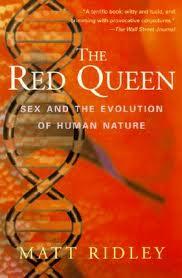
Talk to The Red Queen: Sex and the Evolution of Human Nature like its author wrote you back.
Get the ideas that fit your life — not generic summaries.
- Chat with the book
- Audiobook-style main ideas
- Adapts to your life and goals
- Helps you take action
What it argues
The Red Queen takes its title from Lewis Carroll's Through the Looking-Glass, where the Red Queen tells Alice she must keep running just to stay in the same place. Matt Ridley applies this metaphor to evolution: organisms must constantly change to stay ahead of parasites, competitors, and their own evolutionary history. For Ridley, sex — the central topic of the book — exists primarily because of this arms race. Asexual reproduction is more efficient, but sexually reproducing organisms keep shuffling their genetic defenses fast enough to outpace the parasites that evolve to exploit them.
The book moves from this theory of why sex exists to the evolutionary logic of how animals choose mates, and then to what that logic implies about human psychology and society. Ridley covers sexual selection theory thoroughly, drawing on Darwin, W. D. Hamilton, and the subsequent explosion of research in the field. He explains why females of most species are more choosy than males — the asymmetry follows from which sex makes the larger biological investment in offspring — and uses this framework to analyze everything from peacock tails to human preferences in partners.
What it gets right
- 1.
Sex exists not merely for reproduction but as an evolutionary strategy: genetic recombination creates diverse offspring that are harder for parasites to exploit than clones would be.
- 2.
The Red Queen hypothesis holds that organisms must keep evolving simply to maintain fitness against rapidly co-evolving parasites and competitors — there is no stable end state.
- 3.
Sexual selection operates differently in males and females because of differing reproductive investment. Females generally invest more, which makes them choosier and makes competition sharper among males.
What it covers
Who wrote it
Matt Ridley is a British science writer and member of the House of Lords. He was born in 1958 and studied zoology at Oxford. He was science editor of The Economist for several years before writing full-time. His books include Genome, Nature Via Nurture, The Rational Optimist, and The Evolution of Everything. The Red Queen was his second major book and remains his most influential work on evolutionary biology. He is known for clear, argumentative prose and for engaging directly with controversial implications of evolutionary thinking rather than avoiding them.
