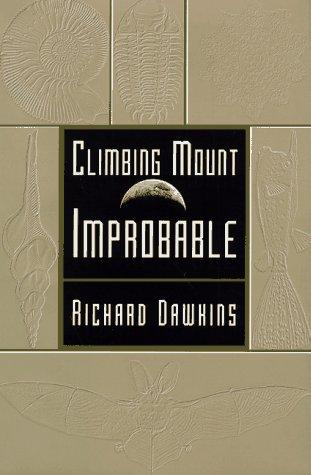
Talk to Climbing Mount Improbable like its author wrote you back.
Get the ideas that fit your life — not generic summaries.
- Chat with the book
- Audiobook-style main ideas
- Adapts to your life and goals
- Helps you take action
Climbing Mount Improbable, in detail
Climbing Mount Improbable is Richard Dawkins's response to the persistent intuition that complex biological structures — the vertebrate eye, insect wings, spider webs — are too improbable to have evolved by chance. The central metaphor is a mountain with sheer cliffs on one side and a gradual slope on the other. The cliffs represent the apparent improbability of reaching the summit in a single leap, which is what creationist arguments implicitly assume. The slope represents the actual mechanism of evolution: small, incremental improvements accumulating over vast time scales.
The book makes the argument in a series of case studies. The evolution of the eye receives extended treatment, with Dawkins drawing on computer simulations and the fossil record to show that every intermediate form — from a patch of light-sensitive cells to a fully formed camera eye — is functional and offers a survival advantage. The diversity of eye types across the animal kingdom, he argues, is not evidence against evolution but evidence that eyes have evolved independently dozens of times, because the slope up Mount Improbable is gradual enough to climb repeatedly.
Later chapters cover figs and fig wasps — one of the most intricate coevolutionary relationships in nature — spider webs and their structural engineering, and the apparent design of seeds and their dispersal mechanisms. Each case follows the same logic: what looks designed is the product of cumulative selection operating on variation. Dawkins is particularly good on arms races, the evolutionary dynamics where predator and prey, parasite and host, or competing species drive each other's escalating sophistication.
Where The Selfish Gene changed how biologists thought about the unit of selection, Climbing Mount Improbable is aimed more at the general reader confronting the intuitive implausibility of complex adaptation. The tone is patient rather than combative, and Dawkins's enthusiasm for the material — particularly the fig wasp biology — is genuine and contagious. It remains one of the clearest extended expositions of how natural selection produces functional complexity.
The big ideas
- 1.
The apparent improbability of complex biological structures is an illusion created by imagining they had to arrive all at once. Natural selection builds them incrementally over millions of generations.
- 2.
The vertebrate eye has evolved independently at least 40 times across the animal kingdom. Each convergent evolution of similar optical solutions supports, rather than challenges, Darwinian logic.
- 3.
Arms races between predators and prey, parasites and hosts, and competing species drive the escalating complexity we observe in nature — neither side can stop without being overtaken.
