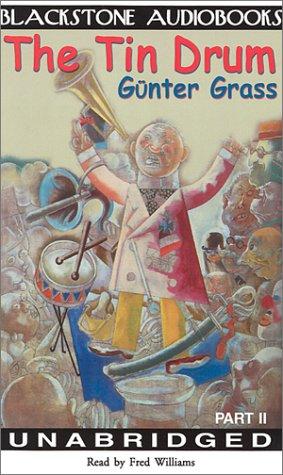
Talk to The Tin Drum like its author wrote you back.
Get the ideas that fit your life — not generic summaries.
- Chat with the book
- Audiobook-style main ideas
- Adapts to your life and goals
- Helps you take action
The Tin Drum, in detail
The Tin Drum is narrated by Oskar Matzerath, a man writing from a mental institution in postwar West Germany. At age three, Oskar decided to stop growing — he observed the adult world around him and concluded it was not worth joining — and to mark his refusal he produced a scream capable of shattering glass. He carries a tin drum throughout the novel, which covers the years of Weimar Germany, the Nazi period, the war, and the aftermath, all filtered through Oskar's distorted, unreliable, deliberately grotesque memory.
Grass is doing several things at once. The novel is a Bildungsroman turned inside out: Oskar does not grow up, does not become part of society, does not acquire the moral clarity that coming-of-age is supposed to deliver. He is complicit in events he refuses to name directly. The drumming is both his protest and his evasion — it allows him to claim the position of helpless observer while actively participating in everything he claims to reject. Grass is making a point about German society's postwar claim of innocence: Oskar is Germany looking at itself in a funhouse mirror.
The prose is carnivalesque, Rabelaisian, deliberately excessive — Grass piles detail on detail, loops back, contradicts himself, mixes the scatological with the lyrical. This is not accident but form: the novel argues that fascism cannot be confronted with realist narrative because realism implies a coherent moral narrator, and Germany had forfeited the right to coherence. The result is one of the great formally experimental novels of the twentieth century and one of the most demanding to read.
Readers who love Pynchon, Garcia Márquez, or Gunter Grass's fellow German modernists will find it immediately recognizable. Readers expecting a conventional war novel will be disoriented. It is grotesque, funny, morally serious, and very long. The Nobel Committee, awarding Grass the prize in 1999, called it a work that had transformed the literature of its era.
The big ideas
- 1.
Oskar's refusal to grow is not heroism but evasion — a way of claiming the moral high ground of innocence while remaining present and complicit throughout the Nazi period.
- 2.
The tin drum is Grass's central metaphor: a child's toy repurposed as an instrument of both protest and self-protection, loud enough to drown out the questions Oskar refuses to answer.
- 3.
Grass uses the grotesque — Oskar's glass-shattering scream, the eel scene, Oskar's account of his own conception — to refuse the consolations of realist narrative about the Nazi period.
