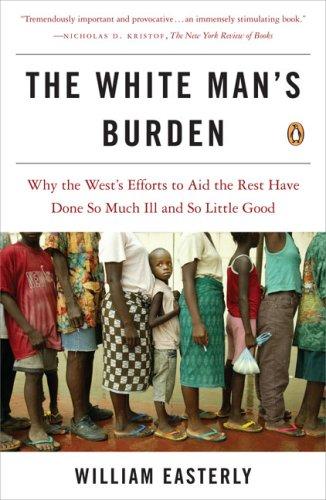
Talk to The White Man's Burden: Why the West's Efforts to Aid the Rest Have Done So Much Ill and So Little Good like its author wrote you back.
Get the ideas that fit your life — not generic summaries.
- Chat with the book
- Audiobook-style main ideas
- Adapts to your life and goals
- Helps you take action
The White Man's Burden: Why the West's Efforts to Aid the Rest Have Done So Much Ill and So Little Good, in detail
William Easterly spent two decades as a research economist at the World Bank before writing The White Man's Burden, and that institutional experience gives his critique of the development industry a quality that most outside critiques lack: he knows exactly how the machine works and why it produces what it does. His central argument is that Western aid efforts fail not because of insufficient funding or inadequate planning, but because of a fundamental organizational problem. The planners who design and implement aid programs are not accountable to the people they are supposed to help.
Easterly's framework is built around a distinction between Planners and Searchers. Planners — the IMF, World Bank, Western governments, and development NGOs — arrive with comprehensive solutions designed in Washington or London and measure success by inputs rather than outputs: money spent, schools built, nets distributed. Searchers, by contrast, look for what actually works in specific local contexts, respond to feedback, and are accountable for outcomes rather than activities. Markets are one example of a search process; so are successful local entrepreneurs and some small-scale NGOs. The development establishment systematically favors Planning over Searching.
The book is full of examples of aid programs that achieved their stated objectives while failing to improve lives: schools built without teachers, roads built without maintenance budgets, medicines distributed without functioning supply chains. Easterly is particularly sharp on the debt-relief-and-conditionality cycle, in which development banks lend money, conditioned on policy reforms that governments don't implement, then forgive the debt, then lend more money with the same conditions. The cycle has repeated dozens of times across the same countries.
Easterly is not an aid abolitionist. He argues for smaller, more targeted interventions that can be evaluated and adjusted — distributing bed nets, oral rehydration therapy, childhood vaccines — rather than the grand comprehensive programs that generate press coverage and conference papers but little measurable improvement. The argument is presented with empirical rigor and a dry wit that makes the book more readable than its policy focus might suggest.
The big ideas
- 1.
The fundamental problem of Western aid is the accountability gap: planners are accountable to donors in the West, not to the poor they are supposed to serve, and that misalignment shapes every incentive in the system.
- 2.
The Planner vs. Searcher distinction captures a real difference in organizational logic: planners impose solutions from above, while searchers discover what works from below through trial, error, and feedback.
- 3.
The debt-conditionality cycle — lend, reform conditions not met, forgive, lend again — has repeated so many times across so many countries that it can only be understood as an institutional feature, not a series of mistakes.
