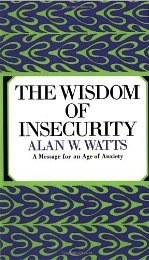
Talk to The Wisdom of Insecurity like its author wrote you back.
Get the ideas that fit your life — not generic summaries.
- Chat with the book
- Audiobook-style main ideas
- Adapts to your life and goals
- Helps you take action
The Wisdom of Insecurity, in detail
The Wisdom of Insecurity, published in 1951, is Alan Watts's argument that the anxiety pervading modern life is a direct consequence of the attempt to find permanent security in an impermanent world. Watts was writing in the early postwar period, when religious certainty was fading and science had not replaced it with anything people could live by — but his diagnosis reads as accurately now as it did then.
The core argument is that the self we are trying to protect and secure is itself the source of the problem. When we stand apart from experience trying to manage it, categorize it, and make it safe, we cut ourselves off from the only place where life is actually happening: the present moment. Watts draws on Eastern philosophy — particularly Zen and Taoism — without reducing them to self-help formulas. His claim is not that you should try to be more present but that you already are present when you stop trying to escape to a safer version of it.
Watts is sharp about the way the mind uses the future as a refuge from the present. Planning, worrying, and anticipating are all ways of pretending that real life is somewhere other than here. At the same time, he does not advocate passivity. The book argues that action from within experience, rather than action in resistance to it, is more fluid and less exhausting. He illustrates this with physical metaphors — swimming, falling, riding a wave — that manage to avoid feeling like clichés.
The book is not a manual. It does not give you exercises or systems. What it gives you is a way of reconsidering the premises under which the anxiety operates. Readers who arrive expecting concrete techniques will be frustrated; readers who are willing to sit with the ideas will find them surprisingly durable. The Wisdom of Insecurity is one of those books that people reread at different ages and keep finding new things in.
The big ideas
- 1.
The attempt to achieve permanent security is itself the source of anxiety. Security, in the conventional sense, is not available in an impermanent world.
- 2.
The self that is trying to be secured — a fixed, permanent identity — is a mental construction, not a thing. Most of our suffering defends something that isn't quite real.
- 3.
The present moment is the only place where experience is happening. The mind's move to past regret or future worry is a flight from the only real location.
