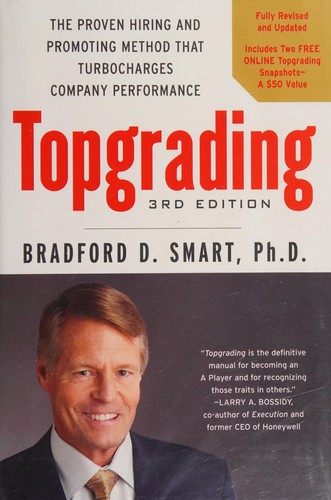
Talk to Topgrading: The Proven Hiring and Promoting Method That Turbocharges Company Performance like its author wrote you back.
Get the ideas that fit your life — not generic summaries.
- Chat with the book
- Audiobook-style main ideas
- Adapts to your life and goals
- Helps you take action
Topgrading: The Proven Hiring and Promoting Method That Turbocharges Company Performance, in detail
Topgrading is Bradford Smart's comprehensive argument that companies succeed or fail primarily based on whether they have high performers — A-players — in every role, and that most organizations are far worse at identifying and retaining them than they believe. Smart spent decades as an executive coach and assessor, and Topgrading is both his methodology and a detailed account of what separates A-player thinking from the rest.
The book's central method is a long structured interview called the Topgrading Interview, which can run three to four hours or more. Like the Who interview in the later book by Smart's son Geoff, it is chronological: the interviewer walks through every job in the candidate's history, exploring successes, failures, key relationships, and the candidate's own self-assessment of performance. The length is deliberate. Smart argues that patterns only emerge over time, and that candidates can maintain a false performance for an hour but rarely for three. Tandem interviewing — two interviewers in the room simultaneously — reduces individual bias.
Smart also addresses what to do with existing employees. Topgrading isn't just a hiring method; it's a talent-management philosophy that involves regularly assessing everyone in the organization, coaching B-players toward A-player performance, and making the difficult decision to remove C-players before their mediocrity becomes the cultural norm. Smart is explicit that most leaders avoid these conversations and that the avoidance compounds over time.
The book is thorough to the point of density. At its core is a single, sustained claim: the average manager misassesses candidates at a high rate because interviews are short, unstructured, and designed to let candidates perform rather than reveal. The Topgrading approach is expensive in time and requires training to execute well, but Smart's case for investing in it rests on the multiplication effect of talent — one A-player can outperform several B-players in roles that require judgment, creativity, or leadership.
The big ideas
- 1.
A-players are the top 10 percent of available talent for a given compensation level. Most organizations settle for B- and C-players without realizing it because their interview process can't distinguish them.
- 2.
The Topgrading Interview is a multi-hour structured chronological walkthrough of a candidate's career. Length and structure together surface patterns that short interviews reliably miss.
- 3.
Tandem interviewing — two trained interviewers present simultaneously — reduces individual bias and increases the probability that both interviewers probe the same signals.
