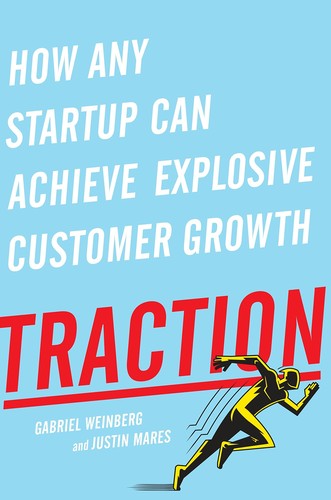
Talk to Traction: How Any Startup Can Achieve Explosive Customer Growth like its author wrote you back.
Get the ideas that fit your life — not generic summaries.
- Chat with the book
- Audiobook-style main ideas
- Adapts to your life and goals
- Helps you take action
What it argues
Traction is Gabriel Weinberg and Justin Mares's systematic guide to customer acquisition for startups. Weinberg founded DuckDuckGo, the privacy-focused search engine, and interviewed more than forty successful startup founders for the book. The central argument is that most startups don't fail because of product — they fail because they can't get traction, and most founders make the mistake of assuming that one obvious channel is right for their business without systematically testing alternatives.
The book identifies nineteen traction channels: viral marketing, public relations, unconventional PR, search engine marketing, social and display ads, offline ads, search engine optimization, content marketing, email marketing, engineering as marketing, targeting blogs, business development, sales, affiliate programs, existing platforms, trade shows, offline events, speaking engagements, and community building. The variety is the point: most businesses focus on one or two channels while ignoring the others, and the best channel for a specific business is often not the one that seems most obvious.
What it gets right
- 1.
Traction — evidence of customer growth — is as important as product development, and should be pursued in parallel, not sequentially.
- 2.
There are nineteen distinct traction channels. Most startups ignore most of them. The right channel for your business may not be the obvious one.
- 3.
The Bullseye Framework: brainstorm all nineteen channels, identify the top three by potential, run cheap experiments to test each, then concentrate on the one that shows the best results.
What it covers
Who wrote it
Gabriel Weinberg is the CEO and founder of DuckDuckGo, the privacy-focused search engine, and an angel investor. He has been building internet products and studying growth since the early 2000s. Justin Mares is an entrepreneur and investor who previously led growth at Kettle and Fire. Together they researched and interviewed more than forty successful startup founders to produce Traction. Both are based in the US. Weinberg has subsequently been a leading voice on data privacy and the business model of search.
